Which assumptions of the kinetic–molecular theory explain the behavior of gases described by Gay-Lussac's law? Explain your answer.
Verified step by step guidance
1
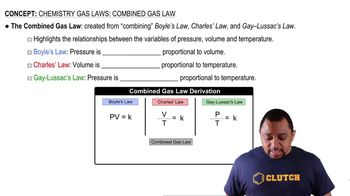
Gay-Lussac's law states that the pressure of a gas is directly proportional to its temperature (in Kelvin) when the volume and the amount of gas are held constant. This can be expressed mathematically as: or , where is a constant.
The kinetic–molecular theory (KMT) provides a framework to explain this behavior. One key assumption of KMT is that the average kinetic energy of gas particles is directly proportional to the absolute temperature of the gas. As temperature increases, the particles move faster, leading to more frequent and forceful collisions with the walls of the container, which increases pressure.
Another assumption of KMT is that gas particles are in constant, random motion and that their collisions with the container walls are perfectly elastic. This means that no energy is lost during collisions, so the increase in kinetic energy due to a temperature rise directly translates to an increase in pressure.
KMT also assumes that the volume of individual gas particles is negligible compared to the volume of the container. This ensures that the behavior of the gas is primarily determined by the motion and collisions of the particles, which aligns with the direct relationship between pressure and temperature described by Gay-Lussac's law.
Finally, KMT assumes that there are no intermolecular forces between gas particles. This allows the gas to behave ideally, meaning the pressure changes are solely due to changes in temperature, as described by Gay-Lussac's law.
Verified video answer for a similar problem:
This video solution was recommended by our tutors as helpful for the problem above
Video duration:
5m
Play a video:
Was this helpful?
Key Concepts
Here are the essential concepts you must grasp in order to answer the question correctly.
Kinetic-Molecular Theory
The kinetic-molecular theory posits that gas consists of a large number of small particles in constant, random motion. This theory explains gas behavior by relating temperature to the average kinetic energy of the particles, suggesting that as temperature increases, particle speed increases, leading to changes in pressure and volume.
Gay-Lussac's law states that the pressure of a gas is directly proportional to its absolute temperature when the volume is held constant. This relationship implies that if the temperature of a gas increases, its pressure will also increase, provided the volume does not change, highlighting the connection between temperature and pressure in gaseous systems.
The assumptions of ideal gases include that gas particles have negligible volume, do not attract or repel each other, and undergo perfectly elastic collisions. These assumptions simplify the behavior of gases and are foundational for understanding how gases respond to changes in temperature and pressure, as described by Gay-Lussac's law.