Pearson+ LogoPearson+ Logo
Ch.9 Solutions
McMurry - Fundamentals of GOB 8th Edition
McMurry8th EditionFundamentals of GOBISBN: 9780134015187Not the one you use?Change textbook
Chapter 9, Problem 39b

The solubility of CO2 gas in water is 0.15 g/100 mL at a CO2 pressure of 760 mmHg.
b. An atmospheric concentration of 380 ppm, CO2 corresponds to a partial pressure of 0.00038 atm. What percentage of the CO2 originally dissolved in the solution in part (a) remains in solution after the soft drink reaches equilibrium with the ambient atmosphere?

Verified step by step guidance
1
Step 1: Understand the relationship between gas solubility and pressure using Henry's Law. Henry's Law states that the solubility of a gas in a liquid is directly proportional to the partial pressure of the gas above the liquid. The formula is: C=kP, where C is the solubility, k is the Henry's Law constant, and P is the partial pressure of the gas.
Step 2: Calculate the Henry's Law constant, k, using the given solubility and pressure in part (a). Rearrange the formula to solve for k: k=CP. Substitute C = 0.15 g/100 mL and P = 760 mmHg (convert to atm: 760 mmHg = 1 atm).
Step 3: Use the calculated Henry's Law constant, k, to determine the solubility of CO₂ at the new partial pressure of 0.00038 atm. Apply the formula C=kP, substituting the new pressure value.
Step 4: Compare the solubility of CO₂ at the new pressure (calculated in Step 3) to the original solubility (0.15 g/100 mL). Calculate the percentage of CO₂ remaining in solution using the formula: Percentage=New SolubilityOriginal Solubility×100.
Step 5: Interpret the result. The percentage calculated in Step 4 represents the fraction of CO₂ that remains dissolved in the solution after equilibrium is reached with the ambient atmosphere.

Verified video answer for a similar problem:

This video solution was recommended by our tutors as helpful for the problem above.
Video duration:
6m
Was this helpful?

Key Concepts

Here are the essential concepts you must grasp in order to answer the question correctly.

Henry's Law

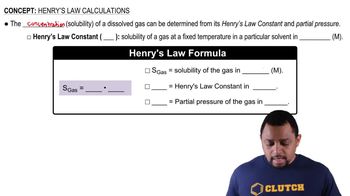
Henry's Law states that the amount of gas that dissolves in a liquid at a given temperature is directly proportional to the partial pressure of that gas above the liquid. This principle is crucial for understanding how changes in pressure affect the solubility of gases like CO₂ in water, which is essential for calculating the equilibrium concentration in the soft drink.
Recommended video:
Guided course
01:41
Henry's Law Calculations Concept 1

Equilibrium

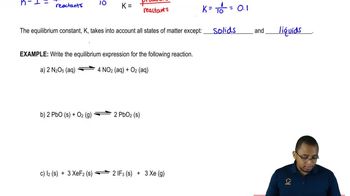
Equilibrium in a chemical context refers to the state where the rate of the forward reaction equals the rate of the reverse reaction, resulting in constant concentrations of reactants and products. In this scenario, it describes the balance between CO₂ dissolved in the soft drink and the CO₂ in the atmosphere, influencing how much gas remains in solution after exposure to ambient conditions.
Recommended video:
Guided course
03:43
The Equilibrium Constant Example 1

Parts Per Million (ppm)

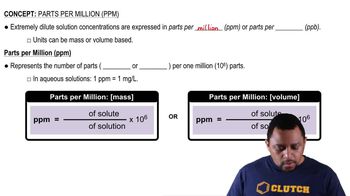
Parts per million (ppm) is a unit of measurement used to describe the concentration of one substance in a million parts of another. In this question, the atmospheric concentration of CO₂ is given in ppm, which helps to determine its partial pressure and how it relates to the solubility of CO₂ in the soft drink, impacting the final equilibrium concentration.
Recommended video:
Guided course
01:38
Parts per Million (ppm) Concept 1