Pearson+ LogoPearson+ Logo
Ch.14 Some Compounds with Oxygen, Sulfur, or a Halogen
McMurry - Fundamentals of GOB 8th Edition
McMurry8th EditionFundamentals of GOBISBN: 9780134015187Not the one you use?Change textbook
Chapter 14, Problem 54

The boiling point of propanol is 97 °C ,much higher than that of either ethanethiol (37 °C) or chloroethane (13 °C) , even though all three compounds have similar MWs. Explain.

Verified step by step guidance
1
Step 1: Identify the molecular structures of the three compounds: Propanol (C3H8O), Ethanethiol (C2H6S), and Chloroethane (C2H5Cl). Note that all three have similar molecular weights but differ in functional groups.
Step 2: Explain the concept of intermolecular forces. Intermolecular forces include hydrogen bonding, dipole-dipole interactions, and London dispersion forces. The strength of these forces determines the boiling point of a substance.
Step 3: Analyze the functional groups in each compound. Propanol contains an -OH group, which allows for hydrogen bonding. Ethanethiol contains an -SH group, which is less electronegative than oxygen and forms weaker hydrogen bonds. Chloroethane contains a -Cl group, which primarily exhibits dipole-dipole interactions and London dispersion forces.
Step 4: Discuss the impact of hydrogen bonding on boiling points. Hydrogen bonding is the strongest intermolecular force among the three compounds. Propanol's ability to form hydrogen bonds significantly increases its boiling point compared to ethanethiol and chloroethane.
Step 5: Conclude that the higher boiling point of propanol is due to the presence of strong hydrogen bonding from its -OH group, whereas ethanethiol and chloroethane lack this capability, resulting in lower boiling points despite similar molecular weights.

Verified video answer for a similar problem:

This video solution was recommended by our tutors as helpful for the problem above.
Was this helpful?

Key Concepts

Here are the essential concepts you must grasp in order to answer the question correctly.

Hydrogen Bonding

Hydrogen bonding is a strong type of dipole-dipole interaction that occurs when hydrogen is bonded to highly electronegative atoms like oxygen or nitrogen. In propanol, the presence of an -OH (hydroxyl) group allows for extensive hydrogen bonding between molecules, significantly raising its boiling point compared to ethanethiol and chloroethane, which lack such strong intermolecular forces.
Recommended video:
Guided course
1:22
Hydrogenation Reactions Concept 1

Molecular Weight vs. Boiling Point

While molecular weight can influence boiling points, it is not the sole determinant. Compounds with similar molecular weights can exhibit vastly different boiling points due to variations in intermolecular forces. In this case, propanol's higher boiling point is attributed to its ability to form hydrogen bonds, whereas ethanethiol and chloroethane rely on weaker van der Waals forces.
Recommended video:
Guided course
03:05
Boiling Point Elevation Concept 1

Intermolecular Forces

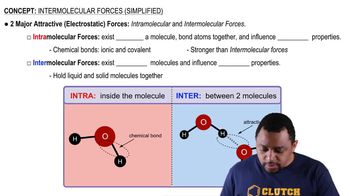
Intermolecular forces are the forces of attraction or repulsion between molecules, which significantly affect physical properties like boiling points. Propanol's strong hydrogen bonds lead to higher boiling points, while ethanethiol and chloroethane, which primarily exhibit weaker London dispersion forces and dipole-dipole interactions, have lower boiling points despite similar molecular weights.
Recommended video:
Guided course
01:59
Intermolecular Forces (Simplified) Concept 1