Pearson+ LogoPearson+ Logo
Ch.16 Amines
McMurry - Fundamentals of GOB 8th Edition
McMurry8th EditionFundamentals of GOBISBN: 9780134015187Not the one you use?Change textbook
Chapter 16, Problem 7a

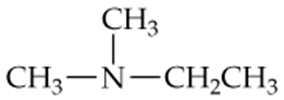
Arrange the following compounds in order of increasing boiling point. Explain why you placed them in that order.
a.

Verified step by step guidance
1
Identify the intermolecular forces present in each compound. Intermolecular forces include London dispersion forces, dipole-dipole interactions, and hydrogen bonding. Stronger intermolecular forces generally lead to higher boiling points.
Analyze the molecular structure of each compound to determine the types of intermolecular forces it exhibits. For example, check for polar bonds (dipole-dipole interactions) or the presence of -OH, -NH, or -FH groups (hydrogen bonding).
Consider the molecular weight of each compound. Larger molecules with greater molecular weights tend to have stronger London dispersion forces, which can increase the boiling point.
Compare the compounds based on the strength of their intermolecular forces and molecular weights. Arrange them in order of increasing boiling point, starting with the compound that has the weakest intermolecular forces and ending with the one that has the strongest.
Explain the reasoning behind the order. For example, if one compound has hydrogen bonding, it will likely have a higher boiling point than a compound with only London dispersion forces. Similarly, a larger molecule with stronger dispersion forces will have a higher boiling point than a smaller molecule with weaker forces.

Verified video answer for a similar problem:

This video solution was recommended by our tutors as helpful for the problem above.
Was this helpful?

Key Concepts

Here are the essential concepts you must grasp in order to answer the question correctly.

Boiling Point

The boiling point of a substance is the temperature at which its vapor pressure equals the external pressure surrounding the liquid, causing it to change into a gas. It is influenced by intermolecular forces, molecular weight, and structural characteristics of the compounds. Generally, stronger intermolecular forces lead to higher boiling points.
Recommended video:
Guided course
03:05
Boiling Point Elevation Concept 1

Intermolecular Forces

Intermolecular forces are the forces of attraction or repulsion between neighboring particles (atoms, molecules, or ions). The main types include hydrogen bonding, dipole-dipole interactions, and London dispersion forces. Compounds with stronger intermolecular forces typically exhibit higher boiling points due to the increased energy required to overcome these forces during the phase change from liquid to gas.
Recommended video:
Guided course
01:59
Intermolecular Forces (Simplified) Concept 1

Molecular Weight

Molecular weight, or molar mass, is the mass of a molecule calculated as the sum of the atomic weights of its constituent atoms. Generally, as molecular weight increases, the boiling point also tends to increase due to greater London dispersion forces, which arise from temporary dipoles in larger molecules. However, this trend can be influenced by the presence of functional groups and the overall molecular structure.
Recommended video:
Guided course
02:08
Molecular Formula