Pearson+ LogoPearson+ Logo
Ch.19 Enzymes and Vitamins
McMurry - Fundamentals of GOB 8th Edition
McMurry8th EditionFundamentals of GOBISBN: 9780134015187Not the one you use?Change textbook
Chapter 19, Problem 63

One mechanism by which lead exerts its poisonous effect on enzymes can be stopped by chelation therapy with EDTA. Describe this type of lead poisoning and explain why it is reversible.

Verified step by step guidance
1
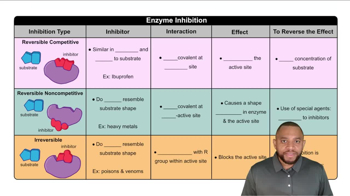
Lead poisoning occurs when lead ions (Pb²⁺) bind to the active sites of enzymes or other critical biomolecules, disrupting their normal function. This happens because lead can mimic other essential metal ions like calcium (Ca²⁺), zinc (Zn²⁺), or iron (Fe²⁺), which are required for enzymatic activity.
When lead binds to enzymes, it forms strong coordination complexes with the enzyme's functional groups, such as sulfhydryl (-SH) or carboxyl (-COOH) groups. This binding alters the enzyme's structure and prevents it from catalyzing reactions effectively.
Chelation therapy with EDTA (ethylenediaminetetraacetic acid) works by introducing a molecule that has multiple binding sites (ligands) capable of forming a stable complex with lead ions. EDTA has four carboxylate groups and two amine groups, which can coordinate with Pb²⁺ ions, effectively sequestering them.
The EDTA-lead complex is highly stable and water-soluble, allowing it to be excreted from the body through the kidneys. This process removes lead from the enzymes and other tissues, restoring the enzyme's ability to function normally.
This type of lead poisoning is reversible because the binding of lead to enzymes is not covalent (permanent). Once the lead is removed via chelation therapy, the enzyme's active site can return to its original state, allowing normal biological activity to resume.

Verified video answer for a similar problem:

This video solution was recommended by our tutors as helpful for the problem above.
Video duration:
4m
Was this helpful?

Key Concepts

Here are the essential concepts you must grasp in order to answer the question correctly.

Lead Poisoning

Lead poisoning occurs when lead builds up in the body, often due to exposure to lead-based paints, contaminated water, or industrial processes. It can interfere with various bodily functions, particularly affecting the nervous system and the production of hemoglobin. Symptoms may include abdominal pain, constipation, fatigue, and neurological impairments, making it a serious health concern.
Recommended video:
Guided course
02:07
Naming Ionic Hydrates Example 1

Chelation Therapy

Chelation therapy is a medical treatment that involves the administration of chelating agents, such as EDTA, which bind to heavy metals in the bloodstream. This binding forms a stable complex that can be excreted from the body, thereby reducing the levels of toxic metals like lead. Chelation therapy is particularly effective in cases of acute lead poisoning, as it helps to mitigate the harmful effects of lead on enzymes and other biological systems.

Reversibility of Lead Poisoning

The reversibility of lead poisoning through chelation therapy is due to the ability of chelating agents to remove lead from the body before it causes permanent damage. When lead is chelated, it is effectively sequestered and eliminated, allowing the body to recover and restore normal enzyme function. This process highlights the importance of early intervention in lead exposure cases, as timely treatment can prevent long-term health consequences.
Recommended video:
Guided course
3:26
Enzyme Inhibition Concept 2