Pearson+ LogoPearson+ Logo
Ch.19 Enzymes and Vitamins
McMurry - Fundamentals of GOB 8th Edition
McMurry8th EditionFundamentals of GOBISBN: 9780134015187Not the one you use?Change textbook
Chapter 19, Problem 59a

What kind of inhibition (uncompetitive, competitive, or irreversible) is present in each of the following:
a. Penicillin is used to treat certain bacterial infections. Penicillin is effective because it binds to the enzyme glycopeptide transpeptidase and does not dissociate.

Verified step by step guidance
1
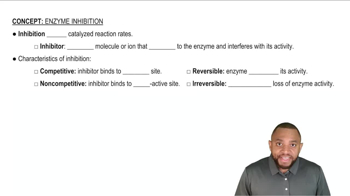
Step 1: Understand the types of enzyme inhibition. Competitive inhibition occurs when an inhibitor competes with the substrate for the active site of the enzyme. Uncompetitive inhibition occurs when the inhibitor binds only to the enzyme-substrate complex. Irreversible inhibition occurs when the inhibitor binds permanently to the enzyme, often through covalent bonds, rendering the enzyme inactive.
Step 2: Analyze the information provided in the problem. Penicillin binds to the enzyme glycopeptide transpeptidase and does not dissociate. This suggests that the binding is permanent or very strong.
Step 3: Recall the characteristics of irreversible inhibition. In irreversible inhibition, the inhibitor forms a stable, often covalent bond with the enzyme, leading to permanent inactivation of the enzyme.
Step 4: Compare the behavior of penicillin to the characteristics of irreversible inhibition. Since penicillin does not dissociate from the enzyme, it aligns with the definition of irreversible inhibition.
Step 5: Conclude that penicillin acts as an irreversible inhibitor of glycopeptide transpeptidase, as it permanently inactivates the enzyme by binding to it.

Verified video answer for a similar problem:

This video solution was recommended by our tutors as helpful for the problem above.
Video duration:
3m
Was this helpful?

Key Concepts

Here are the essential concepts you must grasp in order to answer the question correctly.

Enzyme Inhibition

Enzyme inhibition refers to the process by which a molecule (inhibitor) decreases the activity of an enzyme. This can occur through various mechanisms, including competitive, uncompetitive, and irreversible inhibition, each affecting the enzyme's function differently. Understanding these types is crucial for analyzing how drugs like penicillin interact with bacterial enzymes.
Recommended video:
Guided course
1:19
Enzyme Inhibition Concept 1

Irreversible Inhibition

Irreversible inhibition occurs when an inhibitor binds permanently to an enzyme, often through covalent bonds, leading to a permanent loss of enzyme activity. In the case of penicillin, it binds to glycopeptide transpeptidase and forms a stable complex, effectively preventing the enzyme from catalyzing its reaction, which is essential for bacterial cell wall synthesis.
Recommended video:
Guided course
1:19
Enzyme Inhibition Concept 1

Glycopeptide Transpeptidase

Glycopeptide transpeptidase is an essential enzyme in bacteria that catalyzes the cross-linking of peptidoglycan layers in the bacterial cell wall. This enzyme is a target for antibiotics like penicillin, which inhibit its function, leading to weakened cell walls and ultimately bacterial cell death. Understanding its role helps explain the mechanism of action of penicillin.
Related Practice
Textbook Question

What general effects would you expect the following changes to have on the rate of an enzyme-catalyzed reaction for an enzyme that has its maximum activity at body temperature (about 37°C)?

c. Adding an organic solvent, such as methanol

797
views
Textbook Question

What general effects would you expect the following changes to have on the rate of an enzyme-catalyzed reaction for an enzyme that has its maximum activity at body temperature (about 37°C)?

c. Adding an oxidizing agent, such as hydrogen peroxide

723
views
Textbook Question

The text discusses three forms of enzyme inhibition: uncompetitive inhibition, competitive inhibition, and irreversible inhibition.

b. What kinds of bonds are formed between an enzyme and each of these three kinds of inhibitors?

1654
views
Textbook Question

What kind of inhibition (uncompetitive, competitive, or irreversible) is present in each of the following:

c. The antibiotic deoxycycline inhibits the bacterial enzyme collagenase, slowing bacterial growth. Deoxycycline does not fit into the active site of collagenase and binds elsewhere on the enzyme.

1673
views
Textbook Question

One mechanism by which lead exerts its poisonous effect on enzymes can be stopped by chelation therapy with EDTA. Describe this type of lead poisoning and explain why it is reversible.

1457
views
Textbook Question

The meat tenderizer used in cooking is primarily papain, a protease enzyme isolated from the fruit of the papaya tree. Why do you suppose papain is so effective at tenderizing meat?

1121
views