Pearson+ LogoPearson+ Logo
Ch.19 Enzymes and Vitamins
McMurry - Fundamentals of GOB 8th Edition
McMurry8th EditionFundamentals of GOBISBN: 9780134015187Not the one you use?Change textbook
Chapter 19, Problem 69

What are the cellular advantages to feedback inhibition?

Verified step by step guidance
1
Feedback inhibition is a regulatory mechanism where the end product of a metabolic pathway inhibits an enzyme involved early in the pathway.
This process helps maintain homeostasis by preventing the overproduction of substances within the cell.
By inhibiting the enzyme, feedback inhibition conserves cellular resources and energy, as it stops the pathway when enough product is present.
It allows the cell to respond quickly to changes in the environment or cellular conditions, ensuring efficient use of resources.
Feedback inhibition is a form of negative feedback, which is crucial for maintaining balance and stability in biological systems.

Verified video answer for a similar problem:

This video solution was recommended by our tutors as helpful for the problem above.
Video duration:
5m
Was this helpful?

Key Concepts

Here are the essential concepts you must grasp in order to answer the question correctly.

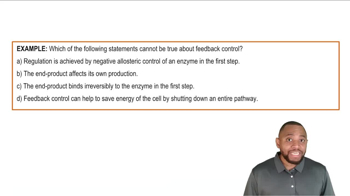
Feedback Inhibition

Feedback inhibition is a regulatory mechanism in cellular metabolism where the end product of a metabolic pathway inhibits an enzyme involved in its synthesis. This process helps maintain homeostasis by preventing the overproduction of substances, ensuring that resources are used efficiently and that metabolic pathways are finely tuned to the cell's needs.
Recommended video:
Guided course
2:08
Feedback Control Example 1

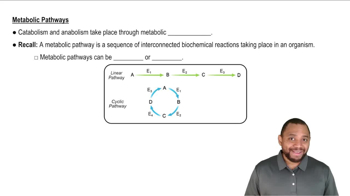
Metabolic Pathways

Metabolic pathways are sequences of chemical reactions occurring within a cell, where the product of one reaction serves as the substrate for the next. Understanding these pathways is crucial for grasping how feedback inhibition operates, as it directly affects the flow of metabolites and the overall efficiency of cellular processes.
Recommended video:
Guided course
0:52
Metabolic Pathways Concept 2

Cellular Homeostasis

Cellular homeostasis refers to the ability of a cell to maintain stable internal conditions despite external changes. Feedback inhibition plays a vital role in this process by regulating enzyme activity and metabolite levels, allowing cells to adapt to varying environmental conditions and maintain optimal functioning.
Recommended video:
Guided course
1:55
Intro to Nucleic Acids Concept 1