
Textbook Question
What kind of reaction does each of these enzymes catalyze?
c. A reductase
1339
views

 Verified step by step guidance
 2:39
2:39
 1:26
1:26 01:37
01:37What kind of reaction does each of these enzymes catalyze?
c. A reductase
What general effects would you expect the following changes to have on the rate of an enzyme-catalyzed reaction for an enzyme that has its maximum activity at body temperature (about 37°C)?
c. Adding an organic solvent, such as methanol
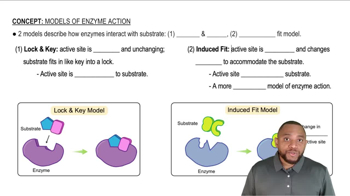
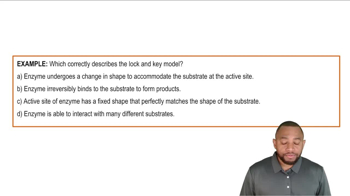
What is the difference between the lock-and-key model of enzyme action and the induced-fit model?
What general effects would you expect the following changes to have on the rate of an enzyme-catalyzed reaction for an enzyme that has its maximum activity at body temperature (about 37°C)?
a. Raising the temperature from 37°C to 70°C
How do you explain the observation that pepsin, a digestive enzyme found in the stomach, has a high catalytic activity at pH 1.5, while trypsin, an enzyme of the small intestine, has no activity at pH 1.5?
Alcohol dehydrogenase (ADH) catalyzes the following reaction. To what class of enzymes does ADH belong?