Pearson+ LogoPearson+ Logo
Ch.21 The Generation of Biochemical Energy
McMurry - Fundamentals of GOB 8th Edition
McMurry8th EditionFundamentals of GOBISBN: 9780134015187Not the one you use?Change textbook
Chapter 21, Problem 22

For the first step in fatty acid catabolism, we say that ATP is used to “drive” the reaction that links the fatty acid with coenzyme-A. Without ATP hydrolysis, would you predict that the linking of fatty acid to coenzyme-A would be ­exergonic or endergonic? In fatty acid CoA synthesis, the hydrolysis of the ATP portion is based on what major strategy of metabolism?

Verified step by step guidance
1
Understand the context: Fatty acid catabolism begins with the activation of the fatty acid by linking it to coenzyme-A (CoA). This reaction requires energy input, which is provided by ATP hydrolysis. The question asks whether this reaction would be exergonic (releases energy) or endergonic (requires energy) without ATP hydrolysis.
Step 1: Recall the definition of endergonic and exergonic reactions. Endergonic reactions require an input of energy to proceed, while exergonic reactions release energy and occur spontaneously. Linking a fatty acid to CoA involves forming a high-energy thioester bond, which is not energetically favorable on its own.
Step 2: Analyze the role of ATP hydrolysis. ATP hydrolysis provides the necessary energy to drive the reaction forward. The hydrolysis of ATP to ADP and inorganic phosphate (Pi) is highly exergonic, and this energy is coupled to the otherwise endergonic reaction of fatty acid-CoA formation.
Step 3: Predict the reaction's nature without ATP hydrolysis. Without the energy provided by ATP hydrolysis, the reaction linking fatty acid to CoA would be endergonic because forming the high-energy thioester bond requires an input of energy.
Step 4: Relate this to a major strategy of metabolism. The hydrolysis of ATP in this process is an example of energy coupling, a fundamental strategy in metabolism. Energy coupling uses the energy released from an exergonic reaction (like ATP hydrolysis) to drive an endergonic reaction (like fatty acid-CoA synthesis).

Verified video answer for a similar problem:

This video solution was recommended by our tutors as helpful for the problem above.
Video duration:
5m
Was this helpful?

Key Concepts

Here are the essential concepts you must grasp in order to answer the question correctly.

Exergonic vs. Endergonic Reactions

Exergonic reactions release energy and occur spontaneously, while endergonic reactions require an input of energy to proceed. In the context of fatty acid catabolism, the linking of fatty acids to coenzyme-A is typically endergonic, meaning it needs energy, which is provided by ATP hydrolysis.
Recommended video:
Guided course
3:33
Enantiomers vs Diastereomers Concept 1

ATP Hydrolysis

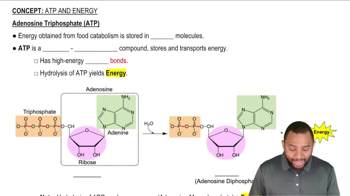
ATP hydrolysis is the process of breaking down adenosine triphosphate (ATP) into adenosine diphosphate (ADP) and inorganic phosphate, releasing energy. This energy is crucial for driving endergonic reactions, such as the activation of fatty acids, making it a key player in metabolic pathways.
Recommended video:
Guided course
2:20
Adenosine Triphosphate (ATP) Concept 2

Metabolic Strategies

In metabolism, one major strategy is the coupling of exergonic and endergonic reactions. By using the energy released from ATP hydrolysis, cells can drive unfavorable reactions forward, such as the synthesis of fatty acyl-CoA, thereby facilitating essential biochemical processes.
Recommended video:
Guided course
0:52
Metabolic Pathways Concept 2