Cholesterol and cholate are sterols with very similar structures. However, the roles they play in the body are different: Cholate is an emulsifier, whereas cholesterol plays an important role in membrane structure. Identify the small differences in their structures that make them well suited to their jobs in the body. Given their similar structures, can the roles of these molecules be reversed?
Ch.24 Lipid Metabolism
Chapter 24, Problem 3
How are long-chain fatty acids released from triacylglycerides transported through the bloodstream?
Verified step by step guidance1
Understand that triacylglycerides are broken down into glycerol and free fatty acids through a process called lipolysis, which occurs in adipose tissue.
Recognize that free fatty acids are hydrophobic and cannot dissolve directly in the aqueous environment of the bloodstream.
Learn that free fatty acids bind to a protein called albumin, which is abundant in the blood plasma and acts as a carrier for hydrophobic molecules.
Understand that the albumin-fatty acid complex allows the long-chain fatty acids to be transported through the bloodstream to tissues where they are needed for energy production or other metabolic processes.
Note that once the fatty acids reach their target cells, they are taken up and can undergo beta-oxidation to generate ATP or be used in other biochemical pathways.

Verified video answer for a similar problem:
This video solution was recommended by our tutors as helpful for the problem above.
Video duration:
4mWas this helpful?
Key Concepts
Here are the essential concepts you must grasp in order to answer the question correctly.
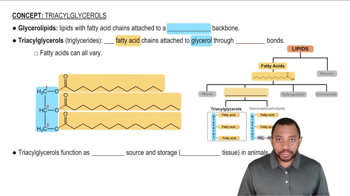
Triacylglycerides
Triacylglycerides, or triglycerides, are the main form of fat stored in the body, composed of three fatty acid molecules esterified to a glycerol backbone. They serve as a major energy source and are found in both dietary fats and body fat. Understanding their structure is essential for grasping how fatty acids are released and utilized.
Recommended video:
Guided course
Triacylglycerols Concept 1
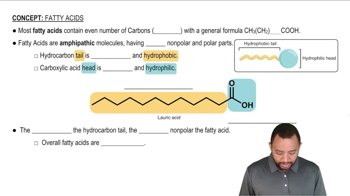
Fatty Acid Release
The release of long-chain fatty acids from triacylglycerides occurs primarily through the action of enzymes called lipases, which hydrolyze the ester bonds. This process is crucial for mobilizing stored fats for energy use, especially during fasting or exercise. The released fatty acids can then enter the bloodstream for transport to various tissues.
Recommended video:
Guided course
Fatty Acids Concept 1
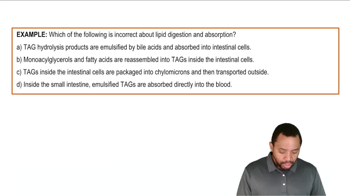
Lipid Transport in Bloodstream
Long-chain fatty acids are not soluble in water, so they require transport proteins to move through the bloodstream. They are typically bound to albumin or incorporated into lipoproteins, such as chylomicrons and very-low-density lipoproteins (VLDL), which facilitate their delivery to tissues for energy production or storage. Understanding this transport mechanism is key to comprehending how fatty acids are utilized by the body.
Recommended video:
Guided course
Digestion of Lipids Example 1
Related Practice
Textbook Question
1175
views
Textbook Question
How many molecules of acetyl-CoA are produced by catabolism of the following fatty acids, and how many β oxidations are needed?
a. Palmitic acid, CH3(CH2)14COOH
519
views
Textbook Question
Look back at the reactions of the citric acid cycle (Figure 21.8) and identify the three reactions in that cycle that are similar to the first three reactions of the β oxidation of a fatty acid.
<IMAGE>
529
views
Textbook Question
Which of the following classifications apply to the formation of 3-hydroxybutyrate from acetoacetate?
a. Condensation
b. Hydrolysis
c. Oxidation
d. Reduction
1082
views