Cholesterol and cholate are sterols with very similar structures. However, the roles they play in the body are different: Cholate is an emulsifier, whereas cholesterol plays an important role in membrane structure. Identify the small differences in their structures that make them well suited to their jobs in the body. Given their similar structures, can the roles of these molecules be reversed?
Ch.24 Lipid Metabolism
Chapter 24, Problem 5a
How many molecules of acetyl-CoA are produced by catabolism of the following fatty acids, and how many β oxidations are needed?
a. Palmitic acid, CH3(CH2)14COOH
Verified step by step guidance1
Step 1: Understand the structure of the fatty acid. Palmitic acid has the formula CH₃(CH₂)₁₄COOH. This means it has a total of 16 carbon atoms (1 from CH₃, 14 from CH₂ groups, and 1 from the COOH group).
Step 2: Recall the process of ß-oxidation. Each cycle of ß-oxidation removes a 2-carbon acetyl group from the fatty acid chain, which is converted into acetyl-CoA. The number of ß-oxidation cycles required is one less than the number of acetyl-CoA molecules produced.
Step 3: Determine the number of acetyl-CoA molecules. Since each acetyl-CoA contains 2 carbons, divide the total number of carbons in palmitic acid (16) by 2. This gives the total number of acetyl-CoA molecules produced.
Step 4: Calculate the number of ß-oxidation cycles. Subtract 1 from the number of acetyl-CoA molecules calculated in Step 3. This is because the final 2-carbon unit does not require an additional ß-oxidation cycle to be released.
Step 5: Summarize the results. The number of acetyl-CoA molecules produced and the number of ß-oxidation cycles required can now be determined based on the calculations in Steps 3 and 4.

Verified video answer for a similar problem:
This video solution was recommended by our tutors as helpful for the problem above.
Video duration:
1mWas this helpful?
Key Concepts
Here are the essential concepts you must grasp in order to answer the question correctly.
Fatty Acid Catabolism
Fatty acid catabolism refers to the metabolic process by which fatty acids are broken down to produce energy. This process primarily occurs in the mitochondria through a series of reactions known as beta-oxidation, where fatty acids are converted into acetyl-CoA units, which then enter the citric acid cycle for further energy production.
Recommended video:
Guided course
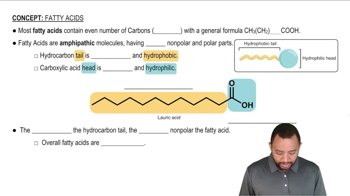
Fatty Acids Concept 1
Beta-Oxidation
Beta-oxidation is the biochemical pathway that breaks down fatty acids into acetyl-CoA. Each cycle of beta-oxidation shortens the fatty acid chain by two carbon atoms, producing one molecule of acetyl-CoA and generating reducing equivalents in the form of NADH and FADH2, which are used in the electron transport chain to produce ATP.
Recommended video:
Guided course
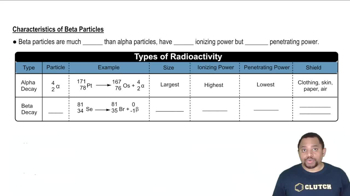
Beta Decay Example 1
Acetyl-CoA Production
Acetyl-CoA is a central metabolite in energy metabolism, formed from the breakdown of carbohydrates, fats, and proteins. In the context of fatty acid catabolism, each molecule of palmitic acid (a 16-carbon fatty acid) undergoes seven cycles of beta-oxidation, yielding eight molecules of acetyl-CoA, which can then be utilized in the citric acid cycle for ATP production.
Recommended video:
Guided course
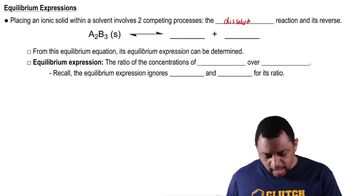
Solubility Product Constant (Ksp) Concept 2
Related Practice
Textbook Question
1175
views
Textbook Question
How are long-chain fatty acids released from triacylglycerides transported through the bloodstream?
719
views
Textbook Question
Look back at the reactions of the citric acid cycle (Figure 21.8) and identify the three reactions in that cycle that are similar to the first three reactions of the β oxidation of a fatty acid.
<IMAGE>
529
views
Textbook Question
Which of the following classifications apply to the formation of 3-hydroxybutyrate from acetoacetate?
a. Condensation
b. Hydrolysis
c. Oxidation
d. Reduction
1082
views
Textbook Question
Consider the reactions of ketogenesis.
c. What is the essential role of ketone bodies during prolonged starvation?
754
views