Pearson+ LogoPearson+ Logo
Ch.24 Lipid Metabolism
McMurry - Fundamentals of GOB 8th Edition
McMurry8th EditionFundamentals of GOBISBN: 9780134015187Not the one you use?Change textbook
Chapter 24, Problem 8

Which of the following classifications apply to the formation of 3-hydroxybutyrate from acetoacetate?
a. Condensation
b. Hydrolysis
c. Oxidation
d. Reduction

Verified step by step guidance
1
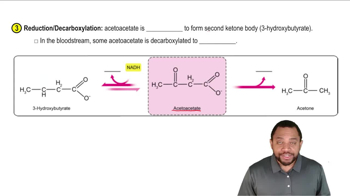
Step 1: Understand the chemical reaction. The formation of 3-hydroxybutyrate from acetoacetate involves the addition of a hydrogen atom to the carbonyl group of acetoacetate, converting it into a hydroxyl group. This is a key clue to the type of reaction occurring.
Step 2: Review the definitions of the given classifications. a) Condensation involves the combination of two molecules with the loss of a small molecule like water. b) Hydrolysis involves breaking a bond using water. c) Oxidation involves the loss of electrons or an increase in oxidation state. d) Reduction involves the gain of electrons or a decrease in oxidation state.
Step 3: Analyze the reaction in terms of oxidation and reduction. The conversion of a carbonyl group (C=O) to a hydroxyl group (C-OH) involves the gain of hydrogen atoms (electrons and protons), which is characteristic of a reduction reaction.
Step 4: Eliminate incorrect classifications. Since no water is involved in breaking bonds, hydrolysis does not apply. Similarly, condensation does not apply because no two molecules are combining with the loss of a small molecule. Oxidation does not apply because there is no loss of electrons or increase in oxidation state.
Step 5: Conclude that the correct classification for the formation of 3-hydroxybutyrate from acetoacetate is reduction, as it involves the gain of hydrogen atoms and a decrease in oxidation state.

Verified video answer for a similar problem:

This video solution was recommended by our tutors as helpful for the problem above.
Video duration:
1m
Was this helpful?

Key Concepts

Here are the essential concepts you must grasp in order to answer the question correctly.

3-Hydroxybutyrate and Acetoacetate

3-Hydroxybutyrate is a ketone body formed from acetoacetate, which is a key intermediate in the metabolism of fatty acids. Understanding the biochemical pathways that involve these compounds is essential for analyzing their formation and transformation in metabolic processes.
Recommended video:
Guided course
1:31
Ketone Bodies Concept 6

Reduction Reaction

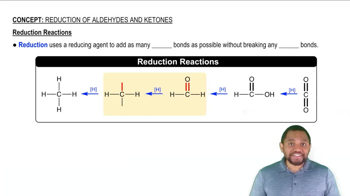
Reduction is a chemical reaction that involves the gain of electrons or hydrogen, resulting in a decrease in oxidation state. In the context of 3-hydroxybutyrate formation, acetoacetate undergoes reduction, which is crucial for converting it into the more reduced form of 3-hydroxybutyrate.
Recommended video:
Guided course
2:38
Reduction Reactions Concept 1

Oxidation-Reduction Reactions

Oxidation-reduction (redox) reactions are fundamental chemical processes where one substance is oxidized (loses electrons) and another is reduced (gains electrons). These reactions are vital in metabolic pathways, including the conversion of acetoacetate to 3-hydroxybutyrate, highlighting the interplay between oxidation and reduction in biological systems.
Recommended video:
Guided course
2:38
Reduction Reactions Concept 1