Pearson+ LogoPearson+ Logo
Ch.13 Carbohydrates
Timberlake - Chemistry: An Introduction to General, Organic, and Biological Chemistry 14th Edition
Timberlake14thChemistry: An Introduction to General, Organic, and Biological ChemistryISBN: 9781292472249Not the one you use?Change textbook
Chapter 13, Problem 29b

Identify the monosaccharide that fits each of the following descriptions:
a. is also called blood sugar

Verified step by step guidance
1
Step 1: Understand the term 'monosaccharide'. Monosaccharides are the simplest form of carbohydrates and cannot be hydrolyzed into smaller carbohydrate units. They are the building blocks of more complex carbohydrates.
Step 2: Recognize the term 'blood sugar'. Blood sugar refers to the primary sugar found in the bloodstream, which is used by the body for energy.
Step 3: Recall the most common monosaccharide associated with blood sugar. This monosaccharide is a six-carbon sugar (hexose) and is classified as an aldose because it contains an aldehyde group.
Step 4: Identify the specific monosaccharide. The monosaccharide commonly referred to as blood sugar is glucose, which has the molecular formula C₆H₁₂O₆.
Step 5: Confirm the role of glucose in the body. Glucose is crucial for cellular respiration, where it is broken down to produce energy in the form of ATP (adenosine triphosphate).

Verified video answer for a similar problem:

This video solution was recommended by our tutors as helpful for the problem above.
Video duration:
1m
Was this helpful?

Key Concepts

Here are the essential concepts you must grasp in order to answer the question correctly.

Monosaccharides

Monosaccharides are the simplest form of carbohydrates, consisting of single sugar molecules. They serve as the building blocks for more complex carbohydrates and are crucial for energy production in living organisms. Common examples include glucose, fructose, and galactose.
Recommended video:
Guided course
0:55
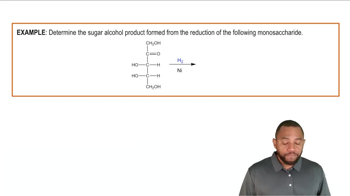
Reduction of Monosaccharides Example 1

Glucose

Glucose is a specific type of monosaccharide that is often referred to as blood sugar. It is a primary energy source for cells and is vital for various metabolic processes. Glucose is absorbed directly into the bloodstream and is essential for maintaining energy levels in the body.
Recommended video:
Guided course
2:07
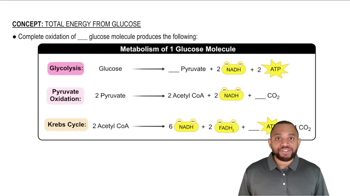
Total Energy From Glucose Concept 1

Blood Sugar Regulation

Blood sugar regulation refers to the mechanisms that maintain glucose levels within a narrow range in the bloodstream. This process involves hormones like insulin and glucagon, which help control the uptake and release of glucose, ensuring that the body has a steady supply of energy while preventing hyperglycemia or hypoglycemia.
Recommended video:
Guided course
1:01
Ketoses as Reducing Sugars Example 2