Pearson+ LogoPearson+ Logo
Ch.15 Lipids
Timberlake - Chemistry: An Introduction to General, Organic, and Biological Chemistry 14th Edition
Timberlake14thChemistry: An Introduction to General, Organic, and Biological ChemistryISBN: 9781292472249Not the one you use?Change textbook
Chapter 15, Problem 2

Which of the following solvents might be used to dissolve an oil stain?
a. water
b. CCl4
c. diethyl ether
d. benzene
e. NaCl solution

Verified step by step guidance
1
Identify the nature of the oil stain. Oil is nonpolar, meaning it does not have a significant separation of charge (no partial positive or negative regions). Nonpolar substances dissolve best in nonpolar solvents due to the principle 'like dissolves like.'
Analyze the polarity of each solvent option: (a) Water is polar, (b) CCl₄ (carbon tetrachloride) is nonpolar, (c) Diethyl ether is slightly polar but has nonpolar regions, (d) Benzene is nonpolar, and (e) NaCl solution is polar due to the ionic nature of Na⁺ and Cl⁻ ions.
Eliminate polar solvents (water and NaCl solution) because they are unlikely to dissolve a nonpolar oil stain effectively.
Focus on the nonpolar solvents: CCl₄ and benzene. These are good candidates for dissolving the oil stain because their nonpolar nature matches the nonpolar nature of the oil.
Consider diethyl ether as a borderline option. While it has some polarity, its nonpolar regions might allow it to dissolve the oil stain to some extent, though it may not be as effective as CCl₄ or benzene.

Verified video answer for a similar problem:

This video solution was recommended by our tutors as helpful for the problem above.
Video duration:
2m
Was this helpful?

Key Concepts

Here are the essential concepts you must grasp in order to answer the question correctly.

Polarity of Solvents

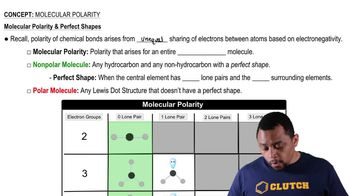
The polarity of a solvent is a key factor in its ability to dissolve substances. Polar solvents, like water, are effective at dissolving ionic and polar compounds, while non-polar solvents, such as benzene and diethyl ether, are better suited for dissolving non-polar substances like oils. Understanding the polarity helps in selecting the appropriate solvent for specific stains.
Recommended video:
Guided course
01:34
Molecular Polarity (Simplified) Concept 1

Solubility Principles

Solubility principles dictate that 'like dissolves like,' meaning that polar solvents dissolve polar solutes and non-polar solvents dissolve non-polar solutes. This principle is crucial when determining which solvent can effectively dissolve an oil stain, as oils are typically non-polar and require non-polar solvents for effective removal.
Recommended video:
Guided course
00:28
Solubility Rules

Common Solvents in Cleaning

Common solvents used in cleaning include organic solvents like benzene, diethyl ether, and carbon tetrachloride (CCl₄), which are effective at breaking down oil-based stains. These solvents are often chosen for their ability to interact with non-polar substances, making them suitable for tasks such as removing oil stains from various surfaces.
Recommended video:
Guided course
0:39
Common Naming Concept 1