Pearson+ LogoPearson+ Logo
Ch.17 Nucleic Acids and Protein Synthesis
Timberlake - Chemistry: An Introduction to General, Organic, and Biological Chemistry 14th Edition
Timberlake14thChemistry: An Introduction to General, Organic, and Biological ChemistryISBN: 9781292472249Not the one you use?Change textbook
Chapter 17, Problem 17

What components join together to form the backbone of a nucleic acid?

Verified step by step guidance
1
Understand that nucleic acids, such as DNA and RNA, are polymers made up of repeating units called nucleotides.
Recognize that each nucleotide consists of three components: a phosphate group, a sugar molecule (deoxyribose in DNA or ribose in RNA), and a nitrogenous base.
Focus on the backbone of the nucleic acid, which is formed by the sugar and phosphate components of the nucleotides, connected through phosphodiester bonds.
Visualize the structure: the phosphate group of one nucleotide forms a covalent bond with the hydroxyl group on the 3' carbon of the sugar in the next nucleotide, creating a sugar-phosphate-sugar-phosphate chain.
Note that the nitrogenous bases are not part of the backbone; they extend from the sugar molecules and are involved in base pairing, which is crucial for the structure and function of nucleic acids.

Verified video answer for a similar problem:

This video solution was recommended by our tutors as helpful for the problem above.
Video duration:
4m
Was this helpful?

Key Concepts

Here are the essential concepts you must grasp in order to answer the question correctly.

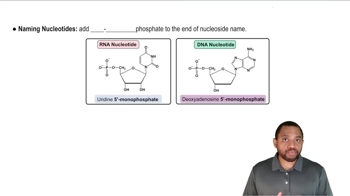
Nucleotides

Nucleotides are the basic building blocks of nucleic acids, consisting of three components: a phosphate group, a five-carbon sugar (ribose in RNA and deoxyribose in DNA), and a nitrogenous base. These molecules link together through phosphodiester bonds to form the long chains that make up the backbone of nucleic acids.
Recommended video:
Guided course
1:21
Naming Nucleosides and Nucleotides Concept 2

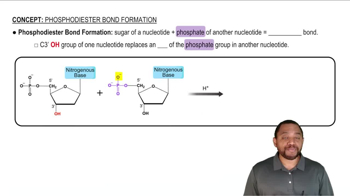
Phosphodiester Bonds

Phosphodiester bonds are covalent linkages that connect the phosphate group of one nucleotide to the hydroxyl group on the sugar of another nucleotide. This bond forms the sugar-phosphate backbone of nucleic acids, providing structural integrity and directionality to the molecule, which is essential for its function in genetic information storage and transfer.
Recommended video:
Guided course
2:19
Phosphodiester Bond Formation Concept 1

Sugar-Phosphate Backbone

The sugar-phosphate backbone is the structural framework of nucleic acids, consisting of alternating sugar and phosphate groups. This backbone supports the attached nitrogenous bases, which encode genetic information. The arrangement of these components determines the overall structure and function of the nucleic acid, whether it be DNA or RNA.
Recommended video:
Guided course
1:01
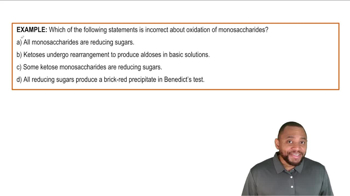
Ketoses as Reducing Sugars Example 2