Pearson+ LogoPearson+ Logo
Ch.3 Matter and Energy
Timberlake - Chemistry: An Introduction to General, Organic, and Biological Chemistry 14th Edition
Timberlake14thChemistry: An Introduction to General, Organic, and Biological ChemistryISBN: 9781292472249Not the one you use?Change textbook
Chapter 3, Problem 84a

Calculate each of the following temperatures in kelvins and degrees Fahrenheit:
a. The highest recorded temperature in the world was 58.0 °C in El Azizia, Libya, on September 13, 1922.

Verified step by step guidance
1
Step 1: Understand the problem. You are tasked with converting a given temperature from degrees Celsius (°C) to both kelvins (K) and degrees Fahrenheit (°F). The given temperature is 58.0 °C.
Step 2: Use the formula to convert Celsius to kelvins. The formula is: K=°C+273.15. Substitute 58.0 for °C in the formula.
Step 3: Use the formula to convert Celsius to Fahrenheit. The formula is: °F=1.8°C+32. Substitute 58.0 for °C in the formula.
Step 4: Perform the addition in the kelvin conversion formula to find the temperature in kelvins. This will give you the temperature in kelvins.
Step 5: Perform the multiplication and addition in the Fahrenheit conversion formula to find the temperature in degrees Fahrenheit. This will give you the temperature in Fahrenheit.

Verified video answer for a similar problem:

This video solution was recommended by our tutors as helpful for the problem above.
Video duration:
2m
Was this helpful?

Key Concepts

Here are the essential concepts you must grasp in order to answer the question correctly.

Temperature Conversion

Temperature conversion involves changing a temperature value from one unit to another, such as Celsius to Kelvin or Fahrenheit. The formulas for these conversions are: for Kelvin, K = °C + 273.15, and for Fahrenheit, °F = (°C × 9/5) + 32. Understanding these formulas is essential for accurately calculating temperatures in different scales.
Recommended video:
Guided course
03:45
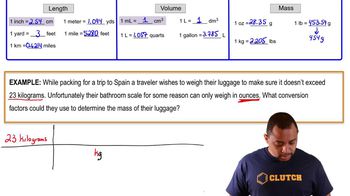
Conversion Factors (Simplified) Example 2

Celsius Scale

The Celsius scale is a temperature scale where 0 °C is the freezing point of water and 100 °C is the boiling point at standard atmospheric pressure. It is widely used in most countries for everyday temperature measurements. Knowing the significance of these reference points helps in understanding the context of temperature readings.
Recommended video:

Kelvin Scale

The Kelvin scale is an absolute temperature scale used primarily in scientific contexts. It starts at absolute zero, the theoretical point where all molecular motion ceases, and is defined such that 0 K is equivalent to -273.15 °C. This scale is crucial in scientific calculations and thermodynamics, making it important to convert temperatures accurately.
Recommended video: