Pearson+ LogoPearson+ Logo
Ch.4 Atoms and Elements
Timberlake - Chemistry: An Introduction to General, Organic, and Biological Chemistry 14th Edition
Timberlake14thChemistry: An Introduction to General, Organic, and Biological ChemistryISBN: 9781292472249Not the one you use?Change textbook
Chapter 4, Problem 80c

Use Rutherford's gold-foil experiment to answer each of the following:
c. How did he use the results to propose a model of the atom?

Verified step by step guidance
1
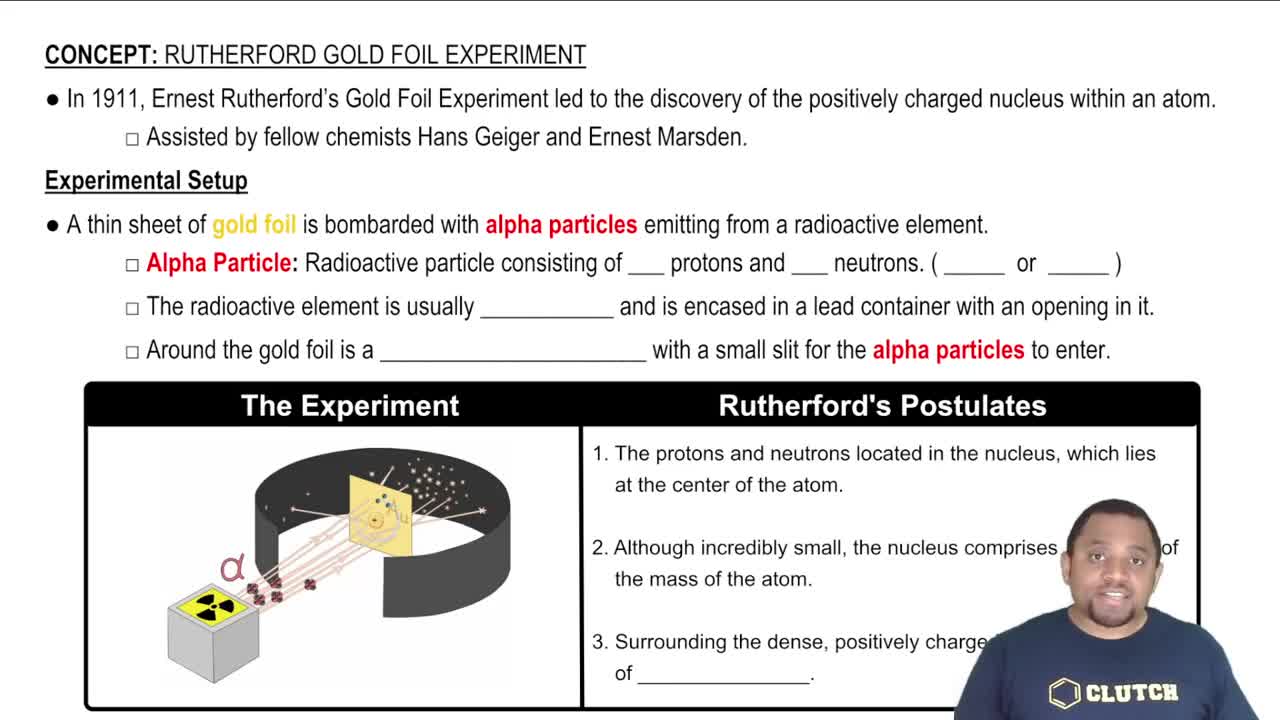
Rutherford's gold-foil experiment involved directing a beam of alpha particles (positively charged particles) at a very thin sheet of gold foil and observing their scattering patterns.
He observed that most of the alpha particles passed straight through the foil with little to no deflection, indicating that atoms are mostly empty space.
A small fraction of the alpha particles were deflected at large angles, and an even smaller number bounced back toward the source, suggesting the presence of a dense, positively charged region within the atom.
Based on these observations, Rutherford proposed a nuclear model of the atom, where the atom consists of a small, dense, positively charged nucleus at the center, surrounded by electrons in the empty space around it.
This model replaced the earlier 'plum pudding' model, which suggested that positive charge was spread out evenly throughout the atom, and provided a foundation for modern atomic theory.

Verified video answer for a similar problem:

This video solution was recommended by our tutors as helpful for the problem above.
Video duration:
5m
Was this helpful?

Key Concepts

Here are the essential concepts you must grasp in order to answer the question correctly.

Rutherford's Gold-Foil Experiment

Rutherford's gold-foil experiment, conducted in 1909, involved firing alpha particles at a thin sheet of gold. Most particles passed through, but some were deflected at large angles, indicating that the atom is mostly empty space with a small, dense nucleus. This unexpected result challenged the existing plum pudding model of the atom and laid the groundwork for the nuclear model.
Recommended video:
Guided course
04:22
Rutherford Gold Foil Oil Experiment

Nuclear Model of the Atom

The nuclear model of the atom, proposed by Rutherford, suggests that an atom consists of a small, positively charged nucleus surrounded by negatively charged electrons. This model replaced the earlier plum pudding model and introduced the concept of a central nucleus, which contains most of the atom's mass, while the electrons orbit around it, similar to planets around the sun.
Recommended video:
Guided course
00:34
Molecular Models Example 1

Deflection of Alpha Particles

The deflection of alpha particles in Rutherford's experiment was crucial for understanding atomic structure. The significant deflections indicated that the nucleus must be positively charged and very small compared to the overall size of the atom. This observation led to the conclusion that the nucleus is responsible for the majority of an atom's mass and positive charge, fundamentally altering the understanding of atomic structure.
Recommended video:
Guided course
01:33
Alpha Decay Concept 2