Pearson+ LogoPearson+ Logo
Ch.6 Ionic and Molecular Compounds
Timberlake - Chemistry: An Introduction to General, Organic, and Biological Chemistry 14th Edition
Timberlake14thChemistry: An Introduction to General, Organic, and Biological ChemistryISBN: 9781292472249Not the one you use?Change textbook
Chapter 6, Problem 152b

Classify each of the following as ionic or molecular, and name each:
b. Cl2O7

Verified step by step guidance
1
Step 1: Determine if the compound is ionic or molecular. Ionic compounds are formed between metals and nonmetals, while molecular compounds are formed between nonmetals. Cl₂O₇ consists of chlorine (Cl) and oxygen (O), both of which are nonmetals, so it is a molecular compound.
Step 2: Identify the type of molecular compound. Cl₂O₇ is a binary molecular compound, meaning it consists of two different nonmetal elements.
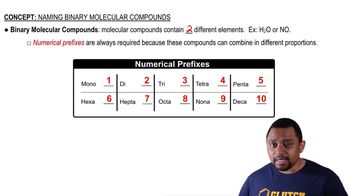
Step 3: Apply the rules for naming molecular compounds. Use prefixes to indicate the number of atoms of each element. The prefix 'di-' is used for two chlorine atoms, and the prefix 'hepta-' is used for seven oxygen atoms.
Step 4: Combine the prefixes with the element names. The name of the first element (chlorine) remains unchanged, while the second element (oxygen) ends with '-ide.' This gives 'dichlorine heptoxide.'
Step 5: Verify the name and classification. The compound is molecular, and its name is 'dichlorine heptoxide,' following the standard naming conventions for molecular compounds.

Verified video answer for a similar problem:

This video solution was recommended by our tutors as helpful for the problem above.
Video duration:
1m
Was this helpful?

Key Concepts

Here are the essential concepts you must grasp in order to answer the question correctly.

Ionic Compounds

Ionic compounds are formed through the electrostatic attraction between positively charged ions (cations) and negatively charged ions (anions). They typically consist of a metal and a non-metal, where the metal donates electrons to the non-metal, resulting in a transfer of charge. This leads to the formation of a crystalline structure with high melting and boiling points.
Recommended video:
Guided course
02:11
Naming Ionic Compounds

Molecular Compounds

Molecular compounds are formed when two or more non-metals share electrons through covalent bonds. These compounds can exist as discrete molecules and often have lower melting and boiling points compared to ionic compounds. They can be classified based on the number of atoms involved, such as diatomic or polyatomic molecules.
Recommended video:
Guided course
01:10
Naming Binary Molecular Compounds Concept 1

Naming Conventions

The naming of ionic and molecular compounds follows specific conventions. Ionic compounds are named by combining the names of the cation and anion, often with the anion ending in '-ide' for simple ions. Molecular compounds use prefixes (mono-, di-, tri-, etc.) to indicate the number of atoms of each element, with the second element typically ending in '-ide'.
Recommended video:
Guided course
0:36
Rules for Naming Thiols Concept 1