Pearson+ LogoPearson+ Logo
Ch.7 Chemical Quantities and Reactions
Timberlake - Chemistry: An Introduction to General, Organic, and Biological Chemistry 14th Edition
Timberlake14thChemistry: An Introduction to General, Organic, and Biological ChemistryISBN: 9781292472249Not the one you use?Change textbook
Chapter 7, Problem 17a

Calculate the molar mass for each of the following:
a. Al2(SO4)3, antiperspirant

Verified step by step guidance
1
Step 1: Identify the elements in the compound Al₂(SO₄)₃ and their respective quantities. The formula indicates 2 aluminum (Al) atoms, 3 sulfur (S) atoms, and 12 oxygen (O) atoms (since each sulfate ion, SO₄, contains 4 oxygen atoms and there are 3 sulfate ions).
Step 2: Look up the atomic masses of each element from the periodic table. For example, the approximate atomic masses are: Al = 26.98 g/mol, S = 32.07 g/mol, and O = 16.00 g/mol.
Step 3: Multiply the atomic mass of each element by the number of atoms of that element in the compound. For aluminum: 2 × 26.98 g/mol. For sulfur: 3 × 32.07 g/mol. For oxygen: 12 × 16.00 g/mol.
Step 4: Add the contributions of all the elements together to calculate the total molar mass of Al₂(SO₄)₃. This is done by summing the results from Step 3.
Step 5: Express the final molar mass in units of g/mol, which represents the mass of one mole of Al₂(SO₄)₃.

Verified video answer for a similar problem:

This video solution was recommended by our tutors as helpful for the problem above.
Video duration:
1m
Was this helpful?

Key Concepts

Here are the essential concepts you must grasp in order to answer the question correctly.

Molar Mass

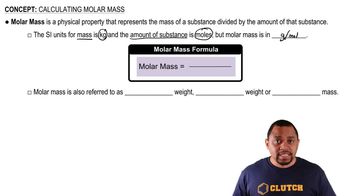
Molar mass is the mass of one mole of a substance, typically expressed in grams per mole (g/mol). It is calculated by summing the atomic masses of all the atoms in a chemical formula. Understanding molar mass is essential for converting between grams and moles, which is crucial in stoichiometry and chemical reactions.
Recommended video:
Guided course
01:10
Calculating Molar Mass

Chemical Formula

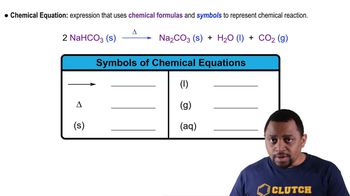
A chemical formula represents the composition of a compound, indicating the types and numbers of atoms present. For example, Al₂(SO₄)₃ shows that the compound contains 2 aluminum (Al) atoms, 3 sulfate (SO₄) groups, and helps in determining the molar mass by identifying each element's contribution.
Recommended video:
Guided course
02:04
Chemical Reaction: Chemical Change Concept 2

Stoichiometry

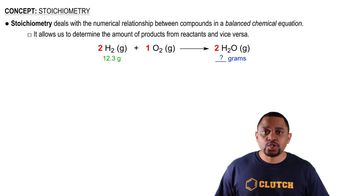
Stoichiometry is the branch of chemistry that deals with the quantitative relationships between reactants and products in chemical reactions. It involves using molar mass to calculate the amounts of substances consumed or produced, making it essential for understanding how to balance equations and perform calculations in chemical processes.
Recommended video:
Guided course
01:16
Stoichiometry