
Ch. 1 - Remembering General Chemistry: Electronic Structure and Bonding
Bruice - Organic Chemistry 8th Edition
Bruice8th EditionOrganic ChemistryISBN: 9780135213711Non è quello che usi tu?Cambia libro di testo
Capitolo 1, Problema 16c,d

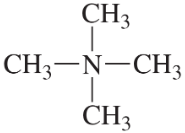
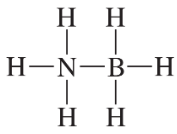
Give each atom the appropriate formal charge:
c.
d.

Guida verificata passo dopo passo
1
Step 1: Recall the formula for calculating formal charge: Formal charge = (Valence electrons) - (Non-bonding electrons) - (1/2 × Bonding electrons). This formula will be applied to each atom in the given structures.
Step 2: For the first structure (tetramethylammonium ion), focus on the nitrogen atom. Nitrogen typically has 5 valence electrons. In this structure, nitrogen is bonded to four methyl groups, forming four single bonds. Since nitrogen has no lone pairs and is sharing 8 bonding electrons, calculate its formal charge using the formula.
Step 3: For the first structure, examine the carbon atoms in the methyl groups. Carbon typically has 4 valence electrons. Each carbon is bonded to three hydrogens and one nitrogen, forming four single bonds. Since there are no lone pairs on these carbons, calculate their formal charges.
Step 4: For the second structure (ammonia-borane complex), focus on the nitrogen atom. Nitrogen has 5 valence electrons. In this structure, nitrogen is bonded to three hydrogens and one boron atom. Nitrogen also has a lone pair of electrons. Use the formal charge formula to determine its charge.
Step 5: For the second structure, examine the boron atom. Boron typically has 3 valence electrons. In this structure, boron is bonded to three hydrogens and one nitrogen atom. Boron has no lone pairs, and it is sharing 8 bonding electrons. Use the formal charge formula to determine its charge.

Risposta video verificata per un problema simile:

Questa soluzione video è stata consigliata dai nostri tutor come utile per risolvere questo problema.
Durata del video:
5m

Concetti chiave

Ecco i concetti essenziali che devi comprendere per rispondere correttamente alla domanda.

Formal Charge

Formal charge is a theoretical charge assigned to an atom in a molecule, calculated based on the number of valence electrons, the number of bonds, and the number of non-bonding electrons. It helps in determining the most stable structure of a molecule by indicating how electrons are distributed among atoms. The formula for calculating formal charge is: Formal Charge = Valence Electrons - (Non-bonding Electrons + 1/2 Bonding Electrons).
Video consigliato:
01:34
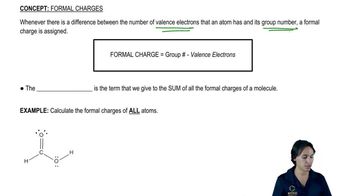
Calculating formal and net charge.

Lewis Structures

Lewis structures are diagrams that represent the bonding between atoms in a molecule and the lone pairs of electrons that may exist. They provide a visual representation of the molecule's structure, allowing for the identification of formal charges and the overall electron distribution. Understanding how to draw and interpret Lewis structures is essential for predicting molecular geometry and reactivity.
Video consigliato:
04:12
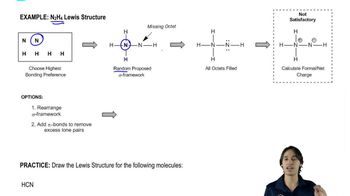
Drawing the Lewis Structure for N2H4.

Hybridization

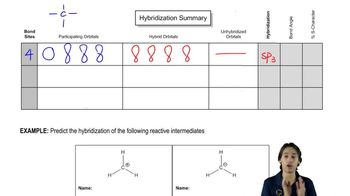
Hybridization is the concept of mixing atomic orbitals to form new hybrid orbitals that can accommodate the bonding requirements of a molecule. In the case of nitrogen in the given structure, it typically undergoes sp³ hybridization, resulting in four equivalent hybrid orbitals that form sigma bonds with surrounding atoms. Recognizing hybridization is crucial for understanding molecular shape and bond angles.
Video consigliato:
10:43
Using bond sites to predict hybridization