Two stereoisomers are obtained from the reaction of cyclopentene oxide and dimethylamine. The R,R-isomer is used in the manufacture of eclanamine, an antidepressant. What other isomer is obtained?
Ch. 10 - Reactions of Alcohols, Ethers, Epoxides, Amines, and Sulfur-Containing Compounds
Tutti i libri di testo
Bruice 8th Edition
Ch. 10 - Reactions of Alcohols, Ethers, Epoxides, Amines, and Sulfur-Containing Compounds
Problema 93b
Bruice 8th Edition
Ch. 10 - Reactions of Alcohols, Ethers, Epoxides, Amines, and Sulfur-Containing Compounds
Problema 93bCapitolo 10, Problema 93b
Although 2-methyl-1,2-propanediol is an unsymmetrical vicinal diol, only one product is obtained when it is dehydrated in an acidic solution.
b. Why is only one product obtained?
Guida verificata passo dopo passo1
Understand the structure of 2-methyl-1,2-propanediol: It is a vicinal diol, meaning it has two hydroxyl (-OH) groups on adjacent carbon atoms. The molecule is unsymmetrical because one of the carbons is substituted with a methyl group.
Recall the mechanism of acid-catalyzed dehydration of vicinal diols: In acidic conditions, one of the hydroxyl groups is protonated, making it a good leaving group (water). This leads to the formation of a carbocation intermediate.
Analyze the carbocation stability: When the hydroxyl group on the carbon with the methyl substituent is protonated and leaves, a tertiary carbocation is formed. Tertiary carbocations are more stable due to hyperconjugation and inductive effects from the methyl group. If the other hydroxyl group leaves, a less stable secondary carbocation would form.
Recognize that the reaction proceeds through the most stable intermediate: The formation of the tertiary carbocation is favored over the secondary carbocation. This ensures that only one pathway is followed during the reaction.
Conclude why only one product is obtained: The dehydration reaction proceeds through the more stable tertiary carbocation intermediate, leading to a single product. The unsymmetrical nature of the diol does not affect the outcome because the reaction is governed by carbocation stability.

Risposta video verificata per un problema simile:
Questa soluzione video è stata consigliata dai nostri tutor come utile per risolvere questo problema.
Durata del video:
8mConcetti chiave
Ecco i concetti essenziali che devi comprendere per rispondere correttamente alla domanda.
Vicinal Diols
Vicinal diols, also known as glycols, are organic compounds that contain two hydroxyl (-OH) groups attached to adjacent carbon atoms. In the case of 2-methyl-1,2-propanediol, the presence of these two -OH groups allows for potential dehydration reactions, where water is eliminated to form alkenes. Understanding the structure of vicinal diols is crucial for predicting the products of their dehydration.
Video consigliato:
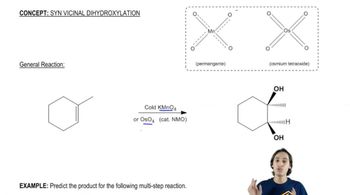
General properties of syn vicinal dihydroxylation.
Dehydration Reaction
A dehydration reaction involves the removal of water from a compound, often leading to the formation of a double bond. In acidic conditions, the hydroxyl groups of vicinal diols can be protonated, making them better leaving groups. This process can lead to the formation of alkenes, but the specific structure of the starting material can influence whether one or multiple products are formed.
Video consigliato:
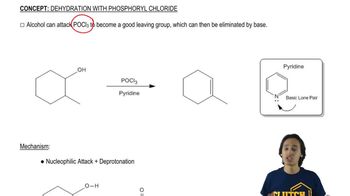
General Reaction of Dehydration with POCl3
Carbocation Stability
The stability of carbocations, which are positively charged carbon species formed during dehydration, plays a significant role in determining the outcome of the reaction. In the case of 2-methyl-1,2-propanediol, the formation of a stable tertiary carbocation leads to a single major product. The unique structure of the diol limits the formation of alternative carbocations, resulting in the exclusive formation of one dehydration product.
Video consigliato:
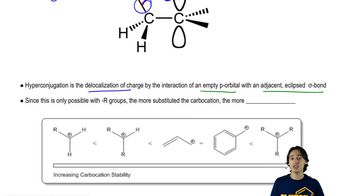
Determining Carbocation Stability
Pratica correlata
Domanda del libro di testo
1261
views
Domanda del libro di testo
What product is obtained when the following vicinal diol is heated in an acidic solution?
1427
views
Domanda del libro di testo
A vicinal diol has OH groups on adjacent carbons. The dehydration of a vicinal diol is accompanied by a rearrangement called the pinacol rearrangement. Propose a mechanism for this reaction.
1683
views
Domanda del libro di testo
Propose a mechanism for each of the following reactions:
a.
1520
views
Domanda del libro di testo
Propose a mechanism for each of the following reactions:
c.
1193
views
Domanda del libro di testo
Although 2-methyl-1,2-propanediol is an unsymmetrical vicinal diol, only one product is obtained when it is dehydrated in an acidic solution.
a. What is this product?
1497
views