

Ch. 10 - Reactions of Alcohols, Ethers, Epoxides, Amines, and Sulfur-Containing Compounds
Bruice - Organic Chemistry 8th Edition
Bruice8th EditionOrganic ChemistryISBN: 9780135213711Non è quello che usi tu?Cambia libro di testo
Capitolo 10, Problema 85b,c

b. A small amount of a product containing a six-membered ring is also formed. Draw the structure of that product.
c. Why is so little six-membered ring product formed?

Guida verificata passo dopo passo
1
Analyze the reaction conditions and the starting materials to determine the possible products. Consider the mechanism of the reaction and how it might lead to the formation of a six-membered ring product.
Draw the structure of the six-membered ring product. This typically involves identifying how the starting materials can rearrange or cyclize to form a six-membered ring. Use curved arrows to show the electron flow leading to the formation of the product.
Explain why the six-membered ring product is formed in small amounts. Consider factors such as steric hindrance, ring strain, or the stability of the transition state leading to the six-membered ring compared to other products.
Discuss the kinetic and thermodynamic factors that influence the formation of the six-membered ring. For example, if the reaction is under kinetic control, the product formed faster (likely a smaller ring) will dominate, whereas under thermodynamic control, the more stable product (possibly the six-membered ring) might form in higher amounts.
Conclude by summarizing why the six-membered ring product is a minor product, emphasizing the interplay of reaction conditions, stability, and reaction pathway preferences.

Risposta video verificata per un problema simile:

Questa soluzione video è stata consigliata dai nostri tutor come utile per risolvere questo problema.
Durata del video:
1m

Concetti chiave

Ecco i concetti essenziali che devi comprendere per rispondere correttamente alla domanda.

Cyclization in Organic Chemistry

Cyclization refers to the process where linear or branched chain molecules form cyclic structures. In organic chemistry, this often involves the formation of rings through the reaction of functional groups, such as alcohols or amines, with electrophiles. The stability and strain of the resulting ring can significantly influence the reaction pathway and product distribution.
Video consigliato:
12:58
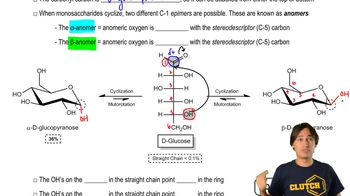
Monosaccharides - Cyclization

Ring Strain

Ring strain occurs in cyclic compounds when the bond angles deviate from the ideal values, leading to increased energy and instability. In six-membered rings, such as cyclohexane, the bond angles are close to the ideal tetrahedral angle of 109.5 degrees, minimizing strain. However, if the formation of a six-membered ring involves unfavorable steric interactions or torsional strain, it may result in lower yields of that product.
Video consigliato:
02:46
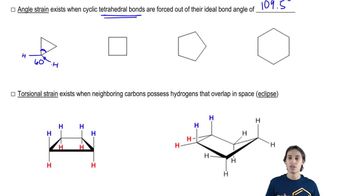
What is angle strain?

Reaction Mechanisms

Understanding reaction mechanisms is crucial for predicting the products of organic reactions. Mechanisms describe the step-by-step process of how reactants transform into products, including the formation and breaking of bonds. In the context of cyclization, the mechanism can reveal why certain products, like the six-membered ring, are formed in smaller amounts due to competing pathways or intermediates that favor alternative products.
Video consigliato:
02:16
Heck Reaction Mechanism