Ch. 10 - Reactions of Alcohols, Ethers, Epoxides, Amines, and Sulfur-Containing Compounds
Bruice - Organic Chemistry 8th Edition
Bruice8th EditionOrganic ChemistryISBN: 9780135213711Non è quello che usi tu?Cambia libro di testo
Capitolo 10, Problema 68

Explain why (S)-2-butanol forms a racemic mixture when it is heated in sulfuric acid.

Guida verificata passo dopo passo
1
Understand the structure of (S)-2-butanol: It is a chiral alcohol with the hydroxyl group (-OH) attached to the second carbon of a four-carbon chain. The (S) configuration indicates that the molecule has a specific spatial arrangement around the chiral center.
Recognize the role of sulfuric acid: Sulfuric acid is a strong acid that can protonate the hydroxyl group of (S)-2-butanol, converting it into a better leaving group (water). This step facilitates the formation of a carbocation intermediate.
Describe the formation of the carbocation: When the hydroxyl group is protonated, it leaves as water, resulting in the formation of a planar carbocation at the second carbon. This carbocation is sp² hybridized and has a trigonal planar geometry, making it achiral.
Explain the racemization process: Because the carbocation is planar, the nucleophile (in this case, water or another molecule) can attack from either side of the plane with equal probability. This leads to the formation of both (R)-2-butanol and (S)-2-butanol in equal amounts, resulting in a racemic mixture.
Conclude the reasoning: The racemic mixture forms because the intermediate carbocation is achiral and allows for non-stereoselective attack by the nucleophile, producing both enantiomers in equal proportions.

Risposta video verificata per un problema simile:

Questa soluzione video è stata consigliata dai nostri tutor come utile per risolvere questo problema.
Durata del video:
6m

Concetti chiave

Ecco i concetti essenziali che devi comprendere per rispondere correttamente alla domanda.

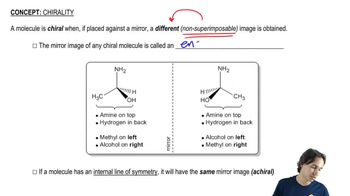
Chirality and Stereoisomers

Chirality refers to the property of a molecule that makes it non-superimposable on its mirror image, leading to the existence of stereoisomers. (S)-2-butanol is a chiral molecule, meaning it has a specific three-dimensional arrangement that can exist in two enantiomeric forms. Understanding chirality is essential to grasp how reactions involving chiral centers can lead to the formation of racemic mixtures.
Video consigliato:
05:10
What is chirality?

Racemic Mixture

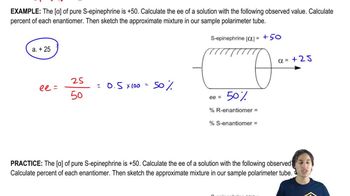
A racemic mixture is a 1:1 mixture of two enantiomers of a chiral compound, resulting in no optical activity. When (S)-2-butanol is heated in sulfuric acid, it can undergo dehydration to form a carbocation intermediate, which can then be attacked by nucleophiles from either side, leading to the formation of both (S)- and (R)-2-butanol. This process illustrates how racemic mixtures can arise from chiral starting materials.
Video consigliato:
03:08
Calculating EE, percent of each enantiomer, and sketching mixture

Carbocation Stability and Rearrangement

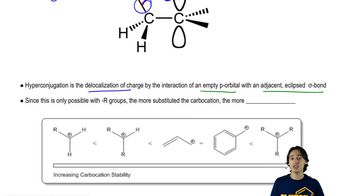
Carbocations are positively charged species that can undergo rearrangements to form more stable structures. In the case of (S)-2-butanol, heating in sulfuric acid generates a carbocation that can rearrange or react in a way that allows for the formation of both enantiomers. The stability of the carbocation and the possibility of different pathways contribute to the racemic outcome of the reaction.
Video consigliato:
05:58
Determining Carbocation Stability
Pratica correlata
Domanda del libro di testo

Explain why the acid-catalyzed dehydration of an alcohol is a reversible reaction, whereas the base-promoted dehydrohalogenation of an alkyl halide is an irreversible reaction.

1925
views

Domanda del libro di testo

a. Draw the product or products that will be obtained from the reaction of cis-2-butene and trans-2-butene with each of the following reagents. If a product can exist as stereoisomers, show which stereoisomers are formed.

8. CH3OH + H2SO4

b. With which reagents do the two alkenes react to form different products?

647
views
Domanda del libro di testo

In Section 10.12, we saw that S-adenosylmethionine (SAM) methylates the nitrogen atom of noradrenaline to form adrenaline, a more potent hormone. If SAM methylates an OH group attached to the benzene ring instead, it completely destroys noradrenaline's activity.

b. Which reaction is more apt to occur, methylation on nitrogen or methylation on oxygen?

1138
views
Domanda del libro di testo

Fill in each box with the appropriate reagent:

a.

1259
views
Domanda del libro di testo

Fill in each box with the appropriate reagent:

c.

1186
views
Domanda del libro di testo

An unknown alcohol with a molecular formula of C7H14O was oxidized to an aldehyde with HOCl. When an acidic solution of the alcohol was distilled, two alkenes were obtained. The alkene formed in greater yield was determined to be 1-methylcyclohexene. The other alkene formed the original un-known alcohol when treated with BH3/THF followed by H2O2, HO-, and H2O. Identify the unknown alcohol.

1117
views