Ch. 10 - Reactions of Alcohols, Ethers, Epoxides, Amines, and Sulfur-Containing Compounds
Bruice - Organic Chemistry 8th Edition
Bruice8th EditionOrganic ChemistryISBN: 9780135213711Non è quello che usi tu?Cambia libro di testo
Capitolo 10, Problema 97b

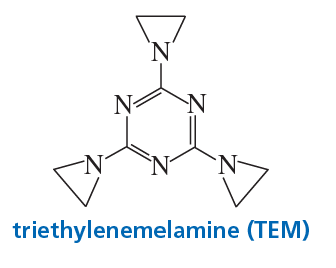
Triethylenemelamine (TEM) is an antitumor agent. Its activity is due to its ability to cross-link DNA.
b. Explain why it can cross-link DNA.
Chemical structure of triethylenemelamine (TEM), an antitumor agent known for cross-linking DNA.

Guida verificata passo dopo passo
1
Step 1: Analyze the structure of Triethylenemelamine (TEM). TEM contains three aziridine rings attached to a triazine core. Aziridine rings are three-membered cyclic amines that are highly strained and reactive due to their small ring size.
Step 2: Understand the reactivity of aziridine rings. Aziridine rings are electrophilic and can undergo nucleophilic attack by groups such as amines or thiols present in DNA. This makes them capable of forming covalent bonds with DNA bases.
Step 3: Explain the mechanism of DNA cross-linking. TEM can react with two nucleophilic sites on DNA, such as guanine bases, through its aziridine rings. This leads to the formation of covalent bonds between two DNA strands or within the same strand, effectively cross-linking the DNA.
Step 4: Discuss the biological implications of DNA cross-linking. Cross-linking prevents DNA replication and transcription, which disrupts cellular processes and leads to cell death. This is why TEM is effective as an antitumor agent.
Step 5: Relate the structure to its function. The triazine core of TEM provides a stable scaffold for the reactive aziridine rings, ensuring that the molecule can interact with DNA effectively and exert its antitumor activity.

Risposta video verificata per un problema simile:

Questa soluzione video è stata consigliata dai nostri tutor come utile per risolvere questo problema.
Durata del video:
5m

Concetti chiave

Ecco i concetti essenziali che devi comprendere per rispondere correttamente alla domanda.

DNA Cross-Linking

DNA cross-linking refers to the formation of covalent bonds between DNA strands, which can inhibit DNA replication and transcription. This process is crucial in the mechanism of action for certain antitumor agents, as it disrupts the normal function of DNA, leading to cell death. Cross-linking can occur through various chemical interactions, often involving electrophilic agents that react with nucleophilic sites on the DNA.
Video consigliato:
Percorso guidato
1:49
DNA Double Helix Example 1

Electrophilicity

Electrophilicity is a chemical property of a species that describes its ability to accept electrons. In the context of DNA cross-linking, electrophilic compounds can react with nucleophilic sites on DNA, such as the nitrogen or oxygen atoms in the bases. Triethylenemelamine (TEM) and related compounds can act as electrophiles, facilitating the formation of cross-links that interfere with DNA function.
Video consigliato:
03:
Nucleophile or Electrophile

Antitumor Mechanism of Action

The antitumor mechanism of action involves various strategies that cancer drugs employ to inhibit tumor growth. For agents like TEM, the primary mechanism is through the induction of DNA damage via cross-linking, which prevents cancer cells from successfully replicating their DNA. This leads to cell cycle arrest and apoptosis, making these agents effective in treating certain types of cancer.
Video consigliato:
04:32
General Mechanism