Ch. 10 - Reactions of Alcohols, Ethers, Epoxides, Amines, and Sulfur-Containing Compounds
Bruice - Organic Chemistry 8th Edition
Bruice8th EditionOrganic ChemistryISBN: 9780135213711Non è quello che usi tu?Cambia libro di testo
Capitolo 10, Problema 11d

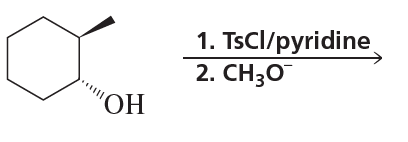
What stereoisomers do the following reactions form?
d. Chemical reaction diagram showing a cyclohexanol derivative reacting with TsCl/pyridine and CH3O-.

Guida verificata passo dopo passo
1
Step 1: Analyze the starting material. The given compound is a chiral alcohol with the hydroxyl group (-OH) attached to a stereogenic center. The stereochemistry is indicated with wedge and dash bonds, showing the spatial arrangement of substituents.
Step 2: Examine the first reaction step. TsCl (tosyl chloride) in the presence of pyridine converts the hydroxyl group into a tosylate group (-OTs). This step retains the stereochemistry of the carbon center because no bond to the stereogenic center is broken.
Step 3: Consider the second reaction step. The tosylate group is a good leaving group, and the ethoxide ion (C₂H₅O⁻) in DMSO promotes an SN2 reaction. In an SN2 reaction, the nucleophile attacks the carbon center from the opposite side of the leaving group, resulting in an inversion of configuration at the stereogenic center.
Step 4: Predict the stereoisomer formed. Since the SN2 reaction inverts the configuration, the product will have the opposite stereochemistry compared to the starting material. If the starting material was R, the product will be S, and vice versa.
Step 5: Summarize the stereochemical outcome. The reaction sequence forms a single stereoisomer due to the stereospecific nature of the SN2 mechanism, which ensures inversion of configuration at the stereogenic center.

Risposta video verificata per un problema simile:

Questa soluzione video è stata consigliata dai nostri tutor come utile per risolvere questo problema.
Durata del video:
4m

Concetti chiave

Ecco i concetti essenziali che devi comprendere per rispondere correttamente alla domanda.

Stereochemistry

Stereochemistry is the study of the spatial arrangement of atoms in molecules and how this affects their chemical behavior. It is crucial for understanding stereoisomers, which are compounds with the same molecular formula and connectivity but different spatial orientations. In reactions like SN2, the stereochemistry of the reactants influences the stereochemical outcome of the products.
Video consigliato:
Percorso guidato
1:38
Polymer Stereochemistry Concept 1

SN2 Mechanism

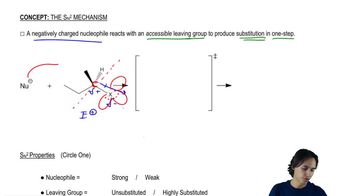
The SN2 (substitution nucleophilic bimolecular) mechanism involves a nucleophile attacking an electrophile, resulting in the simultaneous displacement of a leaving group. This reaction is characterized by a single concerted step and leads to inversion of configuration at the chiral center. Understanding the SN2 mechanism is essential for predicting the stereoisomers formed in the reaction.
Video consigliato:
08:33
Drawing the SN2 Mechanism

Reagents and Conditions

The choice of reagents and reaction conditions significantly influences the outcome of organic reactions. In this case, TsCl (tosyl chloride) and pyridine are used to convert an alcohol into a better leaving group, while DMSO (dimethyl sulfoxide) serves as a polar aprotic solvent that stabilizes the nucleophile. Recognizing how these reagents interact helps in predicting the formation of specific stereoisomers.
Video consigliato:
01:52
Reagents