

Ch. 11 - Organometallic Compounds
Bruice - Organic Chemistry 8th Edition
Bruice8th EditionOrganic ChemistryISBN: 9780135213711Non è quello che usi tu?Cambia libro di testo
Capitolo 11, Problema 31c

Using the given starting material, any necessary inorganic reagents and catalysts, and any carbon-containing compounds with no more than three carbons, indicate how each of the following compounds can be prepared:
c. Chemical reaction showing the conversion of an alkyne to a longer-chain alkyne with structural formulas.

Guida verificata passo dopo passo
1
Step 1: Identify the starting material (CH3CH2C≡CH) and the target product (CH3CH2C≡CCH2CH3). The transformation involves adding a CH2CH3 group to the terminal alkyne.
Step 2: Deprotonate the terminal alkyne (CH3CH2C≡CH) using a strong base such as NaNH2 or LDA to generate the acetylide anion (CH3CH2C≡C⁻). This step is crucial for nucleophilic substitution.
Step 3: Select an appropriate alkyl halide for the alkylation reaction. Since the target product requires a CH2CH3 group, use ethyl bromide (CH3CH2Br) or ethyl iodide (CH3CH2I) as the alkylating agent.
Step 4: Perform the alkylation reaction by reacting the acetylide anion (CH3CH2C≡C⁻) with the ethyl halide (CH3CH2Br or CH3CH2I) under SN2 conditions. This will result in the formation of CH3CH2C≡CCH2CH3.
Step 5: Verify the product structure to ensure the addition of the CH2CH3 group to the terminal alkyne, completing the synthesis of CH3CH2C≡CCH2CH3.

Risposta video verificata per un problema simile:

Questa soluzione video è stata consigliata dai nostri tutor come utile per risolvere questo problema.
Durata del video:
4m

Concetti chiave

Ecco i concetti essenziali che devi comprendere per rispondere correttamente alla domanda.

Alkyne Reactions

Alkynes are hydrocarbons containing at least one carbon-carbon triple bond. They can undergo various reactions, including addition reactions where reagents add across the triple bond. Understanding how to manipulate these reactions is crucial for synthesizing more complex molecules, such as converting 1-butyne (CH3CH2C≡CH) to 1-pentyne (CH3CH2C≡CCH2CH3) through appropriate reagents.
Video consigliato:
01:01
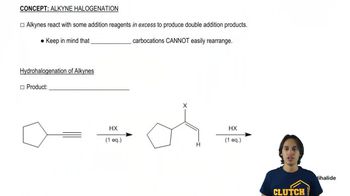
General properties of double addition reactions to alkynes.

Carbon Chain Extension

Carbon chain extension involves adding carbon atoms to a molecule to increase its length. This can be achieved through reactions such as alkylation, where an alkyl group is transferred to a nucleophile. In the context of the question, extending the carbon chain from butyne to pentyne requires a suitable alkylating agent and conditions that favor the formation of the desired product.
Video consigliato:
04:25
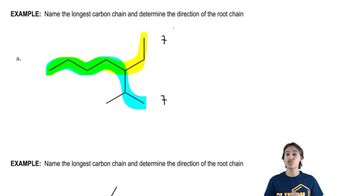
Name the longest carbon chain

Reagents and Catalysts

In organic synthesis, reagents and catalysts play a vital role in facilitating chemical reactions. Reagents are substances that participate in the reaction, while catalysts speed up the reaction without being consumed. Identifying the correct reagents and catalysts is essential for successfully converting starting materials into target compounds, as seen in the transformation of CH3CH2C≡CH to CH3CH2C≡CCH2CH3.
Video consigliato:
Percorso guidato
2:10
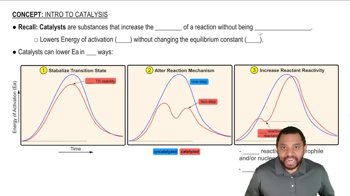
Introduction to Catalysis Concept 1