Ch. 12 - Radicals
Bruice - Organic Chemistry 8th Edition
Bruice8th EditionOrganic ChemistryISBN: 9780135213711Non è quello che usi tu?Cambia libro di testo
Capitolo 12, Problema 12b

Which ether is least apt to form a peroxide?
Four chemical structures labeled A, B, C, and D, depicting different ethers, with a question about peroxide formation.

Guida verificata passo dopo passo
1
Understand the problem: Peroxides are formed when ethers react with oxygen in the air, especially under light or heat. The stability of the ether and the availability of hydrogen atoms adjacent to the oxygen atom (α-hydrogens) play a role in peroxide formation.
Recall the concept: Ethers with α-hydrogens (hydrogens on the carbon atoms directly attached to the oxygen) are more prone to peroxide formation because these hydrogens can be abstracted to form radicals, which then react with oxygen to form peroxides.
Analyze the structure of the ethers: Identify whether the ether has α-hydrogens. For example, diethyl ether (CH₃CH₂OCH₂CH₃) has α-hydrogens, while ethers like tert-butyl methyl ether ((CH₃)₃COCH₃) do not have α-hydrogens on the tert-butyl group.
Determine the least apt ether: Ethers without α-hydrogens are less likely to form peroxides because they lack the necessary hydrogens for radical formation. For example, tert-butyl methyl ether is less prone to peroxide formation compared to diethyl ether.
Conclude: The ether that is least apt to form a peroxide is the one without α-hydrogens, as it cannot easily undergo the radical mechanism required for peroxide formation.

Risposta video verificata per un problema simile:

Questa soluzione video è stata consigliata dai nostri tutor come utile per risolvere questo problema.
Durata del video:
2m

Concetti chiave

Ecco i concetti essenziali che devi comprendere per rispondere correttamente alla domanda.

Ethers

Ethers are organic compounds characterized by an oxygen atom bonded to two alkyl or aryl groups. They are generally stable and non-reactive under normal conditions, but certain structural features can influence their reactivity, particularly in the formation of peroxides. Understanding the structure of ethers is crucial for predicting their behavior in various chemical reactions.
Video consigliato:
04:22
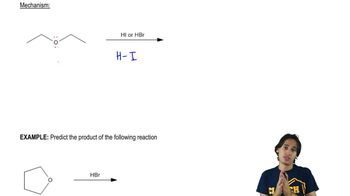
How to predict the products of Ether Cleavage.

Peroxide Formation

Peroxides are compounds containing a peroxide group (–O–O–) and can form from ethers through autoxidation, especially in the presence of light and heat. The likelihood of peroxide formation is influenced by the stability of the ether's structure; more branched or sterically hindered ethers tend to form fewer peroxides. Recognizing the conditions that promote peroxide formation helps in assessing the stability of different ethers.
Video consigliato:
02:26
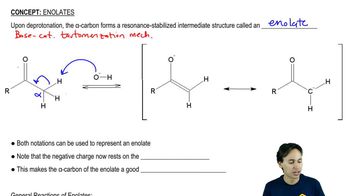
Formation of Enolates

Steric Hindrance

Steric hindrance refers to the prevention of chemical reactions due to the spatial arrangement of atoms within a molecule. In the context of ethers, bulky groups around the ether oxygen can hinder the approach of reactive species, thereby reducing the likelihood of peroxide formation. Understanding steric effects is essential for predicting the reactivity and stability of various ether compounds.
Video consigliato:
02:53
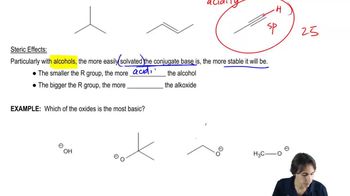
Understanding steric effects.