Ch. 12 - Radicals
Bruice - Organic Chemistry 8th Edition
Bruice8th EditionOrganic ChemistryISBN: 9780135213711Non è quello che usi tu?Cambia libro di testo
Capitolo 12, Problema 6g

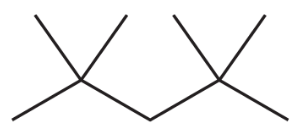
How many alkyl halides are obtained from monochlorination of the alkanes in Problem 4 if stereoisomers are included?
g.

Guida verificata passo dopo passo
1
Identify the structure of the alkane provided in the image. The molecule is 2,3-dimethylpentane, which is a branched alkane.
Determine the unique types of hydrogen atoms in the molecule. These are hydrogens attached to different carbon environments, such as primary, secondary, and tertiary carbons.
Consider the monochlorination reaction, which replaces one hydrogen atom with a chlorine atom. Each unique hydrogen environment will lead to a different alkyl halide product.
Account for stereoisomers. If the chlorination occurs at a chiral center, multiple stereoisomers (R and S configurations) will be formed for that specific product.
Count all possible alkyl halides, including stereoisomers, by analyzing each unique hydrogen environment and determining if the resulting product has chiral centers.

Risposta video verificata per un problema simile:

Questa soluzione video è stata consigliata dai nostri tutor come utile per risolvere questo problema.
Durata del video:
6m

Concetti chiave

Ecco i concetti essenziali che devi comprendere per rispondere correttamente alla domanda.

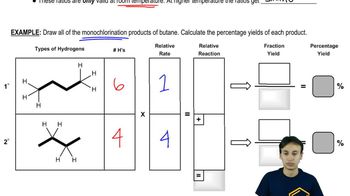
Monochlorination

Monochlorination is a radical substitution reaction where one chlorine atom replaces a hydrogen atom in an alkane. This process typically involves the formation of chlorine radicals, which abstract hydrogen atoms from the alkane, leading to the formation of alkyl halides. The reaction can yield multiple products due to the presence of different hydrogen atoms in the alkane structure, resulting in various alkyl halides.
Video consigliato:
04:37
Draw all of the monochlorination products and calculate percentage yields.

Stereoisomerism

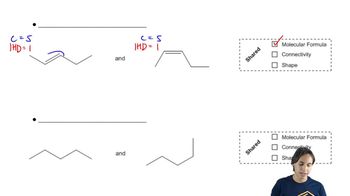
Stereoisomerism refers to the phenomenon where compounds have the same molecular formula and connectivity of atoms but differ in the spatial arrangement of their atoms. In the context of alkyl halides, monochlorination can produce stereoisomers if the chlorine atom is added to a carbon that is chiral or if the resulting alkyl halide can exist in different configurations, such as cis and trans forms. This is crucial for determining the total number of distinct products formed.
Video consigliato:
01:58
Determining when molecules are stereoisomers.

Radical Mechanism

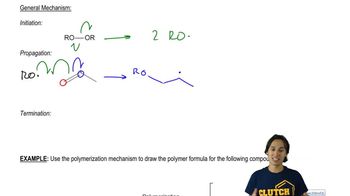
The radical mechanism involves a series of steps including initiation, propagation, and termination, which are characteristic of radical reactions. In monochlorination, the initiation step generates chlorine radicals, which then propagate by reacting with alkanes to form alkyl radicals and further chlorine radicals. Understanding this mechanism is essential for predicting the products and their quantities, including the potential for stereoisomer formation.
Video consigliato:
03:28
The mechanism of Radical Polymerization.