Ch. 12 - Radicals
Bruice - Organic Chemistry 8th Edition
Bruice8th EditionOrganic ChemistryISBN: 9780135213711Non è quello che usi tu?Cambia libro di testo
Capitolo 12, Problema 11a

Show how the following compounds could be prepared from 2-methylpropane:
a. 2-bromo-2-methylpropane 

Guida verificata passo dopo passo
1
Start with 2-methylpropane (isobutane), which has the structure (CH₃)₂CHCH₃. This compound is an alkane and can undergo free radical halogenation to introduce a halogen atom.
Perform a free radical bromination reaction using bromine (Br₂) in the presence of ultraviolet (UV) light or heat. This reaction will selectively brominate the tertiary carbon atom due to its higher stability compared to primary or secondary carbons.
The bromination will yield 2-bromo-2-methylpropane, which has the structure (CH₃)₃CBr. This occurs because the tertiary carbon forms the most stable radical intermediate during the reaction.
Isolate and purify the product, 2-bromo-2-methylpropane, using standard organic chemistry techniques such as distillation or recrystallization, depending on the physical properties of the product.
Verify the structure of the product using spectroscopic methods such as NMR (nuclear magnetic resonance) or IR (infrared spectroscopy) to confirm the presence of the bromine atom on the tertiary carbon.

Risposta video verificata per un problema simile:

Questa soluzione video è stata consigliata dai nostri tutor come utile per risolvere questo problema.
Durata del video:
54s

Concetti chiave

Ecco i concetti essenziali che devi comprendere per rispondere correttamente alla domanda.

Free Radical Halogenation

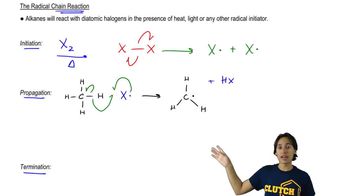
Free radical halogenation is a reaction mechanism where alkanes react with halogens (like Br2) in the presence of heat or light to form alkyl halides. This process involves the formation of free radicals, which are highly reactive species that can abstract hydrogen atoms from the alkane, leading to the substitution of hydrogen with a halogen atom. Understanding this mechanism is crucial for synthesizing compounds like 2-bromo-2-methylpropane from 2-methylpropane.
Video consigliato:
12:11
Radical Chain Reaction Mechanism.

Rearrangement Reactions

Rearrangement reactions involve the structural reorganization of a molecule to form a more stable or reactive isomer. In the case of preparing 2-bromo-2-methylpropane, the formation of a more stable tertiary carbocation from a secondary one can occur during the halogenation process. Recognizing how carbocation stability influences product formation is essential for predicting the outcome of reactions involving branched alkanes.
Video consigliato:
06:28
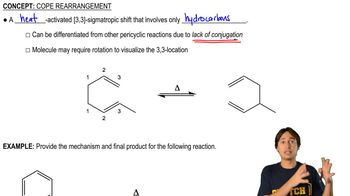
Definition of Cope Rearrangement

Nucleophilic Substitution

Nucleophilic substitution is a fundamental reaction type in organic chemistry where a nucleophile replaces a leaving group in a molecule. In the context of preparing 2-bromo-2-methylpropane, this concept is relevant if considering the conversion of an alcohol derived from 2-methylpropane into the corresponding bromo compound. Understanding the conditions that favor either SN1 or SN2 mechanisms is important for predicting the efficiency and selectivity of the substitution reaction.
Video consigliato:
01:47
Nucleophiles and Electrophiles can react in Substitution Reactions.