Ch. 12 - Radicals
Bruice - Organic Chemistry 8th Edition
Bruice8th EditionOrganic ChemistryISBN: 9780135213711Non è quello che usi tu?Cambia libro di testo
Capitolo 12, Problema 39c

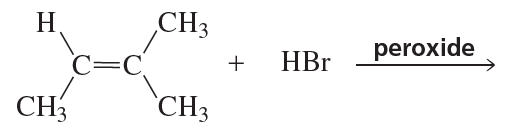
What alkyl halide will be obtained in greatest yield? Ignore stereoisomers.
c. Chemical reaction showing alkene with HBr and peroxide, illustrating anti Markovnikov addition.

Guida verificata passo dopo passo
1
Step 1: Recognize the reaction type. The presence of peroxide indicates that this is a free radical addition of HBr to an alkene, following the anti-Markovnikov rule. This means the bromine atom will add to the less substituted carbon of the double bond.
Step 2: Identify the structure of the alkene. The given alkene is 2-methyl-2-butene, which has a double bond between the second and third carbons.
Step 3: Determine the less substituted carbon in the double bond. In 2-methyl-2-butene, the less substituted carbon is the third carbon, as the second carbon is bonded to three other carbons.
Step 4: Predict the product. The bromine atom will add to the third carbon, and the hydrogen atom will add to the second carbon, resulting in the formation of 3-bromo-2-methylbutane.
Step 5: Confirm the major product. Since the reaction follows the anti-Markovnikov rule and stereoisomers are ignored, the major product will be 3-bromo-2-methylbutane.

Risposta video verificata per un problema simile:

Questa soluzione video è stata consigliata dai nostri tutor come utile per risolvere questo problema.
Durata del video:
4m

Concetti chiave

Ecco i concetti essenziali che devi comprendere per rispondere correttamente alla domanda.

Anti-Markovnikov Addition

Anti-Markovnikov addition refers to the addition of HX (where X is a halogen) to alkenes in a manner that results in the halogen attaching to the less substituted carbon atom. This is typically facilitated by the presence of peroxides, which promote a radical mechanism, leading to the formation of the less stable radical intermediate and ultimately favoring the less substituted product.
Video consigliato:
02:43
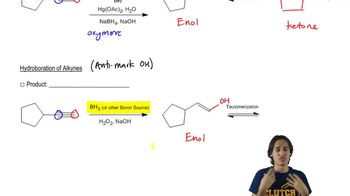
Anti-Markovnikov addition of alcohols to terminal alkynes yields aldehydes

Radical Mechanism

A radical mechanism involves the formation and reaction of free radicals, which are highly reactive species with unpaired electrons. In the context of alkene reactions with HBr in the presence of peroxides, the radical mechanism allows for the anti-Markovnikov addition by generating bromine radicals that add to the alkene, leading to the formation of the product with the bromine on the less substituted carbon.
Video consigliato:
03:28
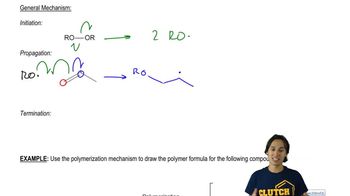
The mechanism of Radical Polymerization.

Alkyl Halides

Alkyl halides are organic compounds derived from alkanes that contain one or more halogen atoms (F, Cl, Br, I) replacing hydrogen atoms. The structure and substitution pattern of the alkyl halide influence its reactivity and stability, which is crucial when determining the yield of products in reactions involving alkenes and halogen acids, especially under radical conditions.
Video consigliato:
01:52
How to name alkyl halides