Ch. 13 - Mass Spectrometry; Infrared Spectroscopy; UV/Vis Spectroscopy
Bruice - Organic Chemistry 8th Edition
Bruice8th EditionOrganic ChemistryISBN: 9780135213711Non è quello che usi tu?Cambia libro di testo
Capitolo 13, Problema 35

A 4.0 × 10⁻⁵ M solution of a compound in hexane shows an absorbance of 0.40 at 252 nm in a cell with a 1 cm light path. What is the molar absorptivity of the compound in hexane at 252 nm?

Guida verificata passo dopo passo
1
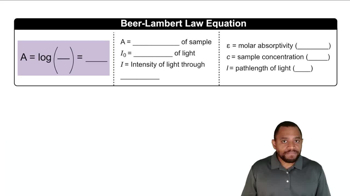
Understand the problem: The question involves calculating the molar absorptivity (ε) of a compound using the Beer-Lambert Law, which is expressed as A = ε * c * l, where A is absorbance, c is the concentration, and l is the path length.
Identify the given values: Absorbance (A) = 0.40, concentration (c) = 4.0 × 10⁻⁵ M, and path length (l) = 1 cm.
Rearrange the Beer-Lambert Law equation to solve for molar absorptivity (ε): ε = A / (c * l).
Substitute the given values into the equation: ε = 0.40 / ((4.0 × 10⁻⁵) * 1).
Simplify the expression to calculate ε, ensuring the units are consistent (M⁻¹ cm⁻¹ for molar absorptivity).

Risposta video verificata per un problema simile:

Questa soluzione video è stata consigliata dai nostri tutor come utile per risolvere questo problema.
Durata del video:
2m

Concetti chiave

Ecco i concetti essenziali che devi comprendere per rispondere correttamente alla domanda.

Beer-Lambert Law

The Beer-Lambert Law relates the absorbance of light by a solution to the concentration of the absorbing species and the path length of the light. It is expressed as A = εlc, where A is absorbance, ε is molar absorptivity, l is the path length in cm, and c is the concentration in mol/L. This law is fundamental for calculating the molar absorptivity of a compound based on its absorbance and concentration.
Video consigliato:
Percorso guidato
1:39
The Beer-Lambert Law Concept 2

Molar Absorptivity (ε)

Molar absorptivity, also known as molar extinction coefficient, is a measure of how strongly a chemical species absorbs light at a given wavelength. It is expressed in units of L/(mol·cm) and is specific to each compound and wavelength. A higher molar absorptivity indicates that a compound is more effective at absorbing light, which is crucial for quantitative analysis in spectroscopy.
Video consigliato:
02:02
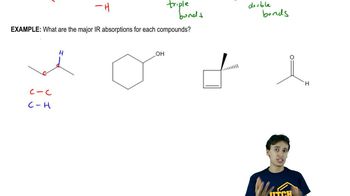
Major IR absorptions

Concentration and Units

Concentration refers to the amount of solute present in a given volume of solution, typically expressed in molarity (M), which is moles of solute per liter of solution. In this question, the concentration of the compound is given as 4.0 * 10^-5 M. Understanding how to convert and manipulate these units is essential for accurately calculating molar absorptivity using the Beer-Lambert Law.
Video consigliato:
Percorso guidato
1:39
The Beer-Lambert Law Concept 2