Ch. 13 - Mass Spectrometry; Infrared Spectroscopy; UV/Vis Spectroscopy
Bruice - Organic Chemistry 8th Edition
Bruice8th EditionOrganic ChemistryISBN: 9780135213711Non è quello che usi tu?Cambia libro di testo
Capitolo 13, Problema 29a,b

How can IR spectroscopy be used to distinguish between the following compounds?
a. a ketone and an aldehyde
b. a cyclic ketone and an open-chain ketone

Guida verificata passo dopo passo
1
Identify the functional groups present in each compound. A ketone contains a carbonyl group (C=O) bonded to two alkyl or aryl groups, while an aldehyde contains a carbonyl group (C=O) bonded to at least one hydrogen atom. Cyclic ketones have the carbonyl group within a ring structure, whereas open-chain ketones have the carbonyl group in a linear or branched chain.
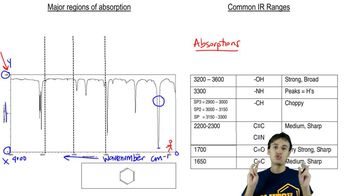
Understand the characteristic IR absorption frequencies for the functional groups. The carbonyl group (C=O) typically absorbs strongly in the range of 1700–1750 cm⁻¹. Aldehydes also exhibit additional characteristic peaks due to the C-H bond stretching of the aldehyde group, which appear as two weak bands around 2700–2900 cm⁻¹.
To distinguish between a ketone and an aldehyde, look for the presence of the aldehyde C-H stretching peaks around 2700–2900 cm⁻¹ in the IR spectrum. These peaks will be absent in the spectrum of a ketone.
To distinguish between a cyclic ketone and an open-chain ketone, examine the exact position of the carbonyl (C=O) stretching peak. The ring strain in cyclic ketones can shift the C=O stretching frequency slightly higher (closer to 1750 cm⁻¹) compared to open-chain ketones, which typically absorb closer to 1715 cm⁻¹. Smaller rings (e.g., cyclopropanone) exhibit even higher frequencies due to increased ring strain.
Compare the IR spectra of the compounds in question, focusing on the regions mentioned above. Use the presence or absence of aldehyde C-H stretching peaks and the position of the carbonyl stretching peak to make the distinctions.

Risposta video verificata per un problema simile:

Questa soluzione video è stata consigliata dai nostri tutor come utile per risolvere questo problema.
Durata del video:
6m

Concetti chiave

Ecco i concetti essenziali che devi comprendere per rispondere correttamente alla domanda.

Infrared (IR) Spectroscopy

IR spectroscopy is an analytical technique used to identify functional groups in organic compounds by measuring the absorption of infrared light. Different bonds and functional groups absorb characteristic wavelengths of IR radiation, producing a spectrum that serves as a molecular 'fingerprint' for the compound.
Video consigliato:
16:04
General Features of IR Spect

Functional Group Identification

In organic chemistry, functional groups are specific groups of atoms within molecules that determine their chemical reactivity and properties. For instance, aldehydes and ketones both contain carbonyl groups (C=O), but they can be distinguished by their unique IR absorption patterns, with aldehydes typically showing a C-H stretch around 2720-2820 cm⁻¹.
Video consigliato:
02:36
Identifying Functional Groups

Structural Differences in Ketones and Aldehydes

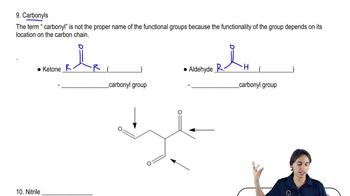
The structural differences between ketones and aldehydes are crucial for their identification. Aldehydes have a carbonyl group at the end of a carbon chain, while ketones have it within the chain. This positional difference affects their IR spectra, allowing for differentiation based on the presence of specific absorption peaks.
Video consigliato:
03:08
The difference between aldehydes and ketones.