Ch. 13 - Mass Spectrometry; Infrared Spectroscopy; UV/Vis Spectroscopy
Bruice - Organic Chemistry 8th Edition
Bruice8th EditionOrganic ChemistryISBN: 9780135213711Non è quello che usi tu?Cambia libro di testo
Capitolo 13, Problema 8

Identify the hydrocarbon that has a molecular ion with an m/z value of 128, a base peak with an m/z value of 43, and significant peaks with m/z values of 57, 71, and 85.

Guida verificata passo dopo passo
1
Step 1: Understand the problem. The molecular ion peak (m/z = 128) represents the molecular weight of the hydrocarbon. The base peak (m/z = 43) is the most intense peak, often corresponding to a stable fragment. The other peaks (m/z = 57, 71, 85) represent additional fragments formed during mass spectrometry.
Step 2: Determine the molecular formula of the hydrocarbon. Since the molecular ion peak is 128, calculate the possible molecular formula by considering hydrocarbons (CnH2n+2 for alkanes, CnH2n for alkenes, etc.). Use the molecular weight to deduce the number of carbon and hydrogen atoms.
Step 3: Analyze the base peak (m/z = 43). This peak often corresponds to a common fragment such as a propyl group (C3H7+) or an isopropyl group. Consider how the hydrocarbon could fragment to produce this peak.
Step 4: Examine the other significant peaks (m/z = 57, 71, 85). These peaks suggest a series of alkyl fragments, likely resulting from the stepwise loss of CH2 groups. This pattern is characteristic of straight-chain or branched alkanes.
Step 5: Propose the structure of the hydrocarbon. Based on the molecular weight (128) and the fragmentation pattern, hypothesize a structure that matches the observed peaks. Verify that the structure can produce the given fragments during mass spectrometry.

Risposta video verificata per un problema simile:

Questa soluzione video è stata consigliata dai nostri tutor come utile per risolvere questo problema.
Durata del video:
13m

Concetti chiave

Ecco i concetti essenziali che devi comprendere per rispondere correttamente alla domanda.

Mass Spectrometry

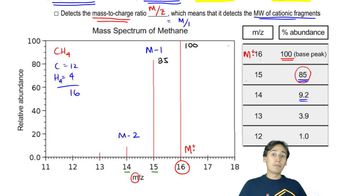
Mass spectrometry is an analytical technique used to measure the mass-to-charge ratio of ions. It helps in identifying the composition of a sample by generating a mass spectrum, which displays the relative abundance of ions at different m/z values. The molecular ion peak corresponds to the intact molecule, while fragment peaks indicate the breakdown of the molecule into smaller parts.
Video consigliato:
01:25
How to Read a Mass Spectrum

Molecular Ion (M+)

The molecular ion, often denoted as M+, represents the ionized form of the entire molecule without any fragmentation. Its m/z value indicates the molecular weight of the compound. In this question, the molecular ion with an m/z value of 128 suggests that the hydrocarbon has a molecular weight of 128 g/mol, which is crucial for identifying the compound.
Video consigliato:
Percorso guidato
3:39
Metal Ion Catalysis Concept 1

Fragmentation Patterns

Fragmentation patterns refer to the specific ways in which a molecule breaks apart during ionization in mass spectrometry. Each fragment has its own m/z value, which can provide insights into the structure of the original molecule. The presence of significant peaks at m/z values of 43, 57, 71, and 85 indicates common fragmentation pathways, which can help deduce the molecular structure and functional groups present in the hydrocarbon.
Video consigliato:
08:06
Common Splitting Patterns