Ch. 13 - Mass Spectrometry; Infrared Spectroscopy; UV/Vis Spectroscopy
Bruice - Organic Chemistry 8th Edition
Bruice8th EditionOrganic ChemistryISBN: 9780135213711Non è quello che usi tu?Cambia libro di testo
Capitolo 13, Problema 70

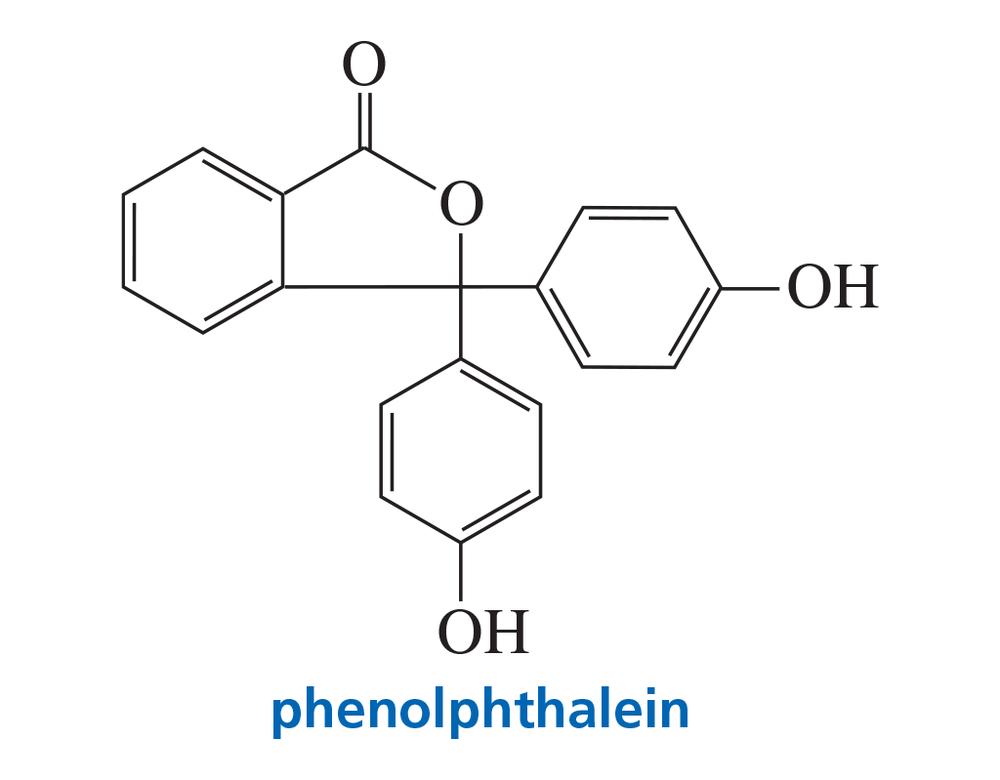
Phenolphthalein is an acid–base indicator. In solutions of pH < 8.5, it is colorless; in solutions of pH > 8.5, it is deep red-purple. Account for the change in color.
Chemical structure of phenolphthalein, an acid-base indicator, with the name displayed in blue text below the structure.

Guida verificata passo dopo passo
1
Phenolphthalein is a pH-sensitive compound that exists in different structural forms depending on the pH of the solution. These structural forms have different colors due to their distinct electronic configurations and absorption of light.
At a pH below 8.5, phenolphthalein exists predominantly in its protonated (acidic) form. This form does not absorb visible light in a way that produces color, so the solution appears colorless.
As the pH increases above 8.5, the solution becomes more basic, and phenolphthalein undergoes deprotonation. This deprotonation leads to the formation of a conjugated structure, which absorbs light in the visible spectrum, resulting in a red-purple color.
The transition from colorless to red-purple occurs because the deprotonated form of phenolphthalein has an extended conjugated π-electron system. This system lowers the energy gap between the ground and excited states, allowing the molecule to absorb light in the visible range.
The observed color change is a result of the equilibrium shift between the protonated (colorless) and deprotonated (red-purple) forms of phenolphthalein, which is influenced by the pH of the solution.

Risposta video verificata per un problema simile:

Questa soluzione video è stata consigliata dai nostri tutor come utile per risolvere questo problema.
Durata del video:
4m

Concetti chiave

Ecco i concetti essenziali che devi comprendere per rispondere correttamente alla domanda.

Acid-Base Indicators

Acid-base indicators are substances that change color in response to changes in pH. They are typically weak acids or bases that exhibit different colors in their protonated and deprotonated forms. Phenolphthalein, for example, is colorless in acidic solutions and turns deep red-purple in basic solutions, making it useful for determining the acidity or basicity of a solution.
Video consigliato:
02:49
The Lewis definition of acids and bases.

pH Scale

The pH scale measures the acidity or basicity of a solution, ranging from 0 to 14. A pH of 7 is considered neutral, values below 7 indicate acidity, and values above 7 indicate basicity. The pH level affects the ionization of indicators like phenolphthalein, which is why its color changes at specific pH thresholds.
Video consigliato:
02:15
The pH scale vs. the pKa scale.

Ionization of Phenolphthalein

Phenolphthalein undergoes ionization depending on the pH of the solution. In acidic conditions (pH < 7), it remains in its protonated form, which is colorless. As the pH increases and the solution becomes basic (pH > 8.5), phenolphthalein loses protons and transitions to its deprotonated form, resulting in a deep red-purple color. This transition is what allows it to serve as an effective pH indicator.
Video consigliato:
04:28
Ionization Potentials