Ch. 14 - NMR Spectroscopy
Bruice - Organic Chemistry 8th Edition
Bruice8th EditionOrganic ChemistryISBN: 9780135213711Non è quello che usi tu?Cambia libro di testo
Capitolo 14, Problema 22a

Draw a diagram like the one shown in Figure 14.12 to predict
a. the relative intensities of the peaks in a triplet.
<IMAGE>

Guida verificata passo dopo passo
1
Understand the concept of spin-spin splitting: A triplet arises in NMR spectroscopy due to the interaction of a nucleus with two equivalent neighboring nuclei, each having a spin quantum number of 1/2. This results in three peaks with relative intensities determined by the Pascal's triangle (1:2:1).
Recall the rule for peak intensities: The relative intensities of the peaks in a multiplet are determined by the binomial coefficients. For a triplet, the coefficients are derived from the expansion of \((a + b)^2\), which gives 1:2:1.
Draw the diagram: Start by sketching three vertical lines to represent the three peaks of the triplet. Ensure the middle peak is twice as tall as the outer two peaks to reflect the 1:2:1 intensity ratio.
Label the peaks: Indicate the relative intensities of the peaks (1:2:1) below each line. Optionally, you can also label the x-axis as 'Chemical Shift (ppm)' and the y-axis as 'Intensity' to make the diagram more informative.
Verify the splitting pattern: Confirm that the splitting pattern corresponds to the number of equivalent neighboring protons (n = 2) using the \(n + 1\) rule, where \(n\) is the number of equivalent protons. For two equivalent protons, the splitting results in a triplet.

Risposta video verificata per un problema simile:

Questa soluzione video è stata consigliata dai nostri tutor come utile per risolvere questo problema.
Durata del video:
11m

Concetti chiave

Ecco i concetti essenziali che devi comprendere per rispondere correttamente alla domanda.

Nuclear Magnetic Resonance (NMR) Spectroscopy

NMR spectroscopy is a powerful analytical technique used to determine the structure of organic compounds. It relies on the magnetic properties of certain nuclei, primarily hydrogen (1H) and carbon (13C), to provide information about the environment of these atoms in a molecule. The resulting spectra display peaks that correspond to different chemical environments, allowing chemists to infer structural details.
Video consigliato:
10:06
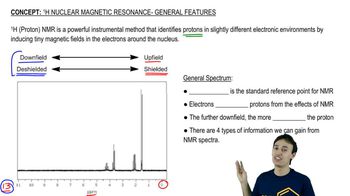
General NMR Features

Spin-Spin Coupling

Spin-spin coupling, or J-coupling, occurs when the magnetic fields of neighboring nuclei influence each other, leading to the splitting of NMR signals into multiple peaks. This phenomenon is crucial for understanding the multiplicity of signals, such as triplets, which arise from the interaction of a proton with two equivalent neighboring protons. The pattern and intensity of these peaks provide insights into the number of adjacent protons and their arrangement.
Video consigliato:
02:54
Sonogashira Coupling Reaction

Peak Intensity and Integration

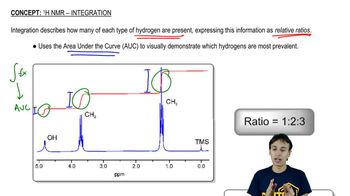
In NMR spectra, the intensity of peaks is proportional to the number of nuclei contributing to that signal. For a triplet, the relative intensities of the peaks follow a specific ratio, typically 1:2:1, reflecting the number of neighboring protons. Understanding peak intensity and integration is essential for quantifying the relative amounts of different hydrogen environments in a molecule, aiding in structural elucidation.
Video consigliato:
06:46
1H NMR Integration