Ch. 14 - NMR Spectroscopy
Bruice - Organic Chemistry 8th Edition
Bruice8th EditionOrganic ChemistryISBN: 9780135213711Non è quello che usi tu?Cambia libro di testo
Capitolo 14, Problema 68

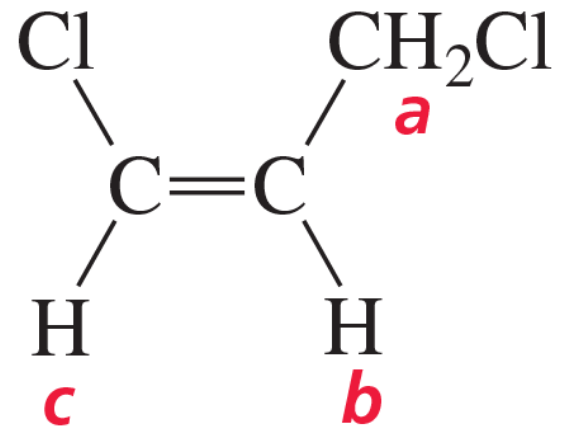
Draw a splitting diagram for the Hb proton if Jbc = 10 and Jba = 5.

Guida verificata passo dopo passo
1
Step 1: Analyze the molecular structure provided in the image. The molecule contains a double bond with three protons labeled Ha, Hb, and Hc. Hb is the proton of interest, and it is coupled to both Ha and Hc.
Step 2: Understand the coupling constants provided. Jbc = 10 Hz represents the coupling between Hb and Hc, while Jba = 5 Hz represents the coupling between Hb and Ha. These values indicate the strength of the spin-spin interactions.
Step 3: Determine the splitting pattern for Hb. Since Hb is coupled to two different protons (Ha and Hc) with different coupling constants, the splitting will result in a doublet of doublets. The larger coupling constant (Jbc = 10 Hz) will cause the initial splitting into two peaks, and the smaller coupling constant (Jba = 5 Hz) will further split each of these peaks into two smaller peaks.
Step 4: Draw the splitting diagram. Start by representing Hb as a single peak. Split this peak into two peaks separated by 10 Hz due to the coupling with Hc. Then, split each of these peaks into two smaller peaks separated by 5 Hz due to the coupling with Ha.
Step 5: Label the diagram appropriately. Indicate the coupling constants (Jbc = 10 Hz and Jba = 5 Hz) on the diagram to show the source of each splitting. Ensure the relative intensities of the peaks are consistent with the expected splitting pattern (1:1:1:1 for a doublet of doublets).

Risposta video verificata per un problema simile:

Questa soluzione video è stata consigliata dai nostri tutor come utile per risolvere questo problema.
Durata del video:
7m

Concetti chiave

Ecco i concetti essenziali che devi comprendere per rispondere correttamente alla domanda.

Nuclear Magnetic Resonance (NMR) Spectroscopy

NMR spectroscopy is a powerful analytical technique used to determine the structure of organic compounds. It relies on the magnetic properties of certain nuclei, such as hydrogen, to provide information about the number of hydrogen atoms and their environment in a molecule. The splitting patterns observed in NMR spectra arise from the interactions between neighboring protons, which is crucial for interpreting the data.
Video consigliato:
10:06
General NMR Features

Spin-Spin Coupling

Spin-spin coupling, or J-coupling, refers to the interaction between the magnetic spins of neighboring nuclei, which leads to the splitting of NMR signals. The coupling constants (J values) quantify the strength of these interactions, measured in Hertz (Hz). In the given question, Jbc = 10 Hz and Jba = 5 Hz indicate the coupling between protons Hb and Hc, and between Hb and H2a, respectively, which will influence the splitting pattern of the Hb proton.
Video consigliato:
02:54
Sonogashira Coupling Reaction

Multiplicity of NMR Signals

The multiplicity of an NMR signal indicates the number of peaks observed for a particular proton signal, which is determined by the number of neighboring protons. This is described by the n+1 rule, where n is the number of neighboring protons. For the Hb proton, the multiplicity will depend on the coupling with protons Hc and H2a, leading to a specific splitting pattern that can be visualized in a splitting diagram.
Video consigliato:
04:35
General Assumption for 1H NMR Signals