Ch. 14 - NMR Spectroscopy
Bruice - Organic Chemistry 8th Edition
Bruice8th EditionOrganic ChemistryISBN: 9780135213711Non è quello che usi tu?Cambia libro di testo
Capitolo 14, Problema 55b

Identify each of the following compounds from the 1H NMR data and molecular formula:
b. C8H9Br: a 3H doublet at 2.01 ppm a 1H quartet at 5.14 ppm
a 5H broad singlet at 7.35 ppm

Guida verificata passo dopo passo
1
Step 1: Analyze the molecular formula C8H9Br. This indicates the compound contains 8 carbons, 9 hydrogens, and 1 bromine atom. The degree of unsaturation can be calculated using the formula: (2C + 2 - H + N - X)/2, where X is the number of halogens. For C8H9Br, the degree of unsaturation is (2(8) + 2 - 9 - 1)/2 = 4, suggesting the presence of aromatic rings or double bonds.
Step 2: Examine the 1H NMR data. The 3H doublet at 2.01 ppm suggests a methyl group adjacent to a CH group, likely part of an ethyl group. The splitting pattern indicates coupling with one neighboring proton.
Step 3: The 1H quartet at 5.14 ppm corresponds to a CH group that is part of an ethyl group. The quartet arises due to coupling with three neighboring protons (the methyl group). This chemical shift suggests the CH group is attached to a bromine atom.
Step 4: The 5H broad singlet at 7.35 ppm is characteristic of an aromatic ring. The singlet indicates that the aromatic ring is monosubstituted, as all five protons resonate together without splitting.
Step 5: Combine the information: The compound has an ethyl group (-CH2-CH3) attached to a bromine atom and a monosubstituted aromatic ring. The structure is consistent with bromomethylbenzene (C6H5-CH2-CH3).

Risposta video verificata per un problema simile:

Questa soluzione video è stata consigliata dai nostri tutor come utile per risolvere questo problema.
Durata del video:
7m

Concetti chiave

Ecco i concetti essenziali che devi comprendere per rispondere correttamente alla domanda.

1H NMR Spectroscopy

Proton Nuclear Magnetic Resonance (1H NMR) spectroscopy is a powerful analytical technique used to determine the structure of organic compounds. It provides information about the number of hydrogen atoms in different environments, their chemical shifts (ppm), and splitting patterns, which indicate the number of neighboring hydrogen atoms. Understanding these signals helps in deducing the molecular structure and functional groups present in the compound.
Video consigliato:
06:46
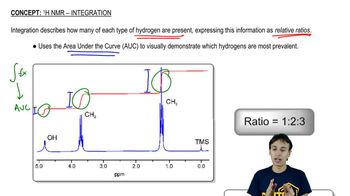
1H NMR Integration

Chemical Shifts and Splitting Patterns

In 1H NMR, chemical shifts are measured in parts per million (ppm) and indicate the electronic environment of hydrogen atoms. The splitting patterns, such as doublets and quartets, arise from the interaction of protons with neighboring protons, following the n+1 rule, where n is the number of neighboring protons. Analyzing these shifts and patterns allows chemists to infer the connectivity and arrangement of atoms in the molecule.
Video consigliato:
08:06
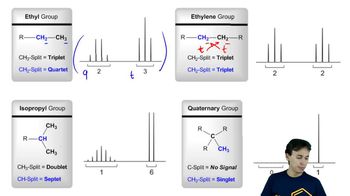
Common Splitting Patterns

Molecular Formula Interpretation

The molecular formula provides essential information about the number and types of atoms in a compound. For C8H9Br, the formula indicates the presence of 8 carbon atoms, 9 hydrogen atoms, and 1 bromine atom. This information, combined with NMR data, helps in identifying the specific structure of the compound, as different structural isomers can have the same molecular formula but different NMR spectra.
Video consigliato:
06:06
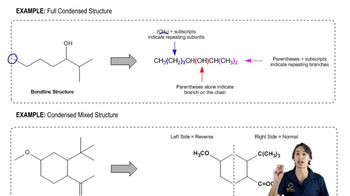
How to interpret condensed structures.