Indietro
Problema 28f
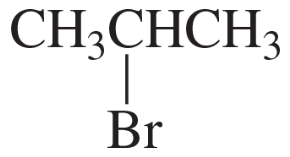
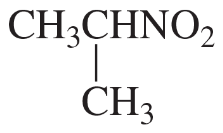
Describe the 1H NMR spectrum you would expect for each of the following compounds, indicating the relative positions of the signals:
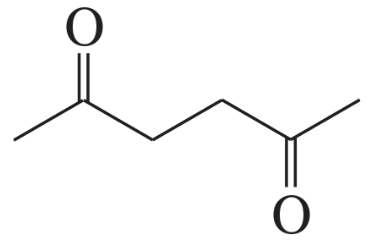
f.
Problema 28g
Describe the 1H NMR spectrum you would expect for each of the following compounds, indicating the relative positions of the signals:
g. CH3CH2OCH2CH3
Problema 28i
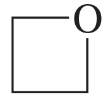
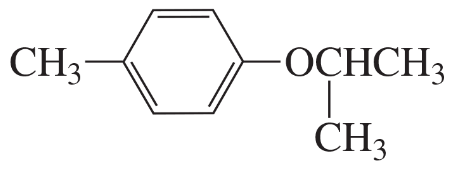
Describe the 1H NMR spectrum you would expect for each of the following compounds, indicating the relative positions of the signals:
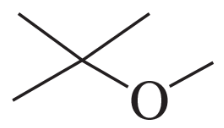
i.
Problema 28k
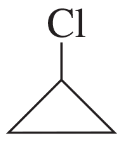
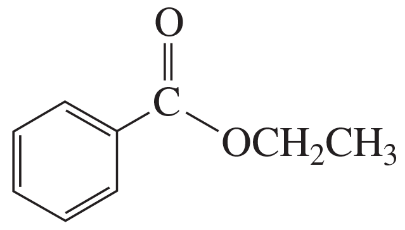
Describe the 1H NMR spectrum you would expect for each of the following compounds, indicating the relative positions of the signals:
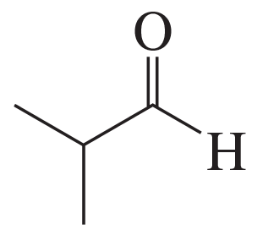
k.
Problema 28n
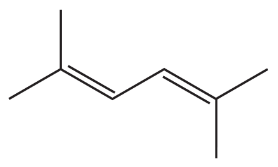
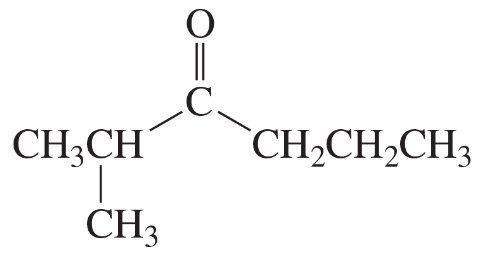
Describe the 1H NMR spectrum you would expect for each of the following compounds, indicating the relative positions of the signals:
n.
Problema 29b
Propose structures that are consistent with the following spectra. (Integral ratios are given from left to right across the spectrum.)
b. The 1H NMR spectrum of a compound with molecular formula C6H10O2 has two singlets with integral ratios of 2 : 3.
Problema 30
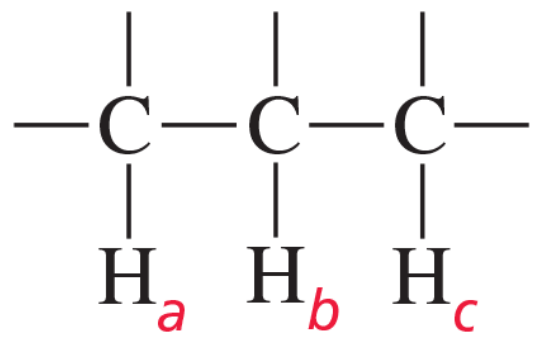
Why is there no coupling between the a and c protons or between the b and c protons in the cis and trans alkenes shown in Figure 14.20?
<IMAGE>
Problema 32a
Draw a splitting diagram for Hb, where
a. Jba = 12 Hz and Jbc = 6 Hz.
Problema 33a(1)
For the following compounds, which pairs of hydrogens (Ha and Hb) are enantiotopic hydrogens?
1.
Problema 33a(c)
For the following compounds, which pairs of hydrogens (Ha and Hb) are enantiotopic hydrogens?
Problema 33b
Which pairs are diastereotopic hydrogens?
Problema 35
How would the 1H NMR spectra for the four compounds with molecular formula C3H6Br2 differ?
Problema 37
Explain why the chemical shift of the OH proton of a carboxylic acid is at a higher frequency than the chemical shift of an OH proton of an alcohol.
Problema 39
Propose a mechanism for proton exchange of an alcohol in aqueous base.
Problema 41(9)
Answer the following questions for each compound:
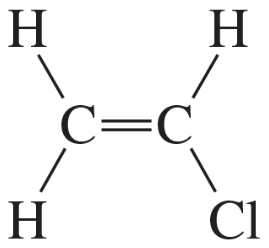
a. How many signals are in its 13C NMR spectrum?
b. Which signal is at the lowest frequency?
9. CH2=CHBr
Problema 41(8)
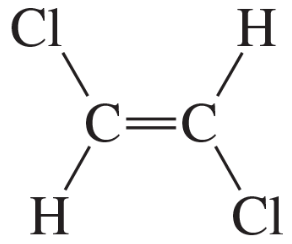
Answer the following questions for each compound:
a. How many signals are in its 13C NMR spectrum?
b. Which signal is at the lowest frequency?
8.
Problema 41a(7)
Answer the following questions for each compound:
a. How many signals are in its 13C NMR spectrum? b. Which signal is at the lowest frequency?
7.
Problema 42(5)
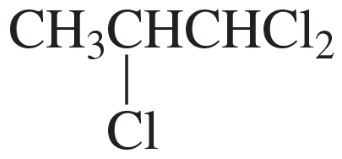
Describe the proton-coupled 13C NMR spectra for compound 5 in Problem 41, indicating the relative positions of the signals.
5.
Problema 42(3)
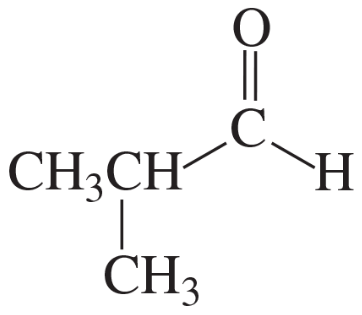
Describe the proton-coupled 13C NMR spectra for compound 3 in Problem 41, indicating the relative positions of the signals.
3.
Problema 42(1)
Describe the proton-coupled 13C NMR spectra for compound 1 in Problem 41, indicating the relative positions of the signals.
1. CH3CH2CH2Br
Problema 43a
How can 1,2-, 1,3-, and 1,4-dinitrobenzene be distinguished by
a. 1H NMR spectroscopy?
Problema 43b
How can 1,2-, 1,3-, and 1,4-dinitrobenzene be distinguished by
b. 13C NMR spectroscopy?
Problema 44a
Identify each compound below from its molecular formula and its 13C NMR spectrum.
a. C11H22O
<IMAGE>
Problema 45
Identify pairs of coupled protons in the compound whose COSY spectrum is shown below.
<IMAGE>
Problema 46
What does cross peak X in Figure 14.34 tell you?
<IMAGE>
Problema 47a(4,5,6)
How many signals are produced by each of the following compounds in its
a. 1H NMR spectrum?
4.
5.
6.
Problema 47b(1)
How many signals are produced by each of the following compounds in its
b. 13C NMR spectrum?
1.
Problema 47b(2)
How many signals are produced by each of the following compounds in its
b. 13C NMR spectrum?
2.
Problema 49a
Label each set of chemically equivalent protons, using a for the set that will be at the lowest frequency in the 1H NMR spectrum, b for the next lowest, and so on. Indicate the multiplicity of each signal.
a.
Problema 49c
Label each set of chemically equivalent protons, using a for the set that will be at the lowest frequency in the 1H NMR spectrum, b for the next lowest, and so on. Indicate the multiplicity of each signal.
c.