Ch. 14 - NMR Spectroscopy
Bruice - Organic Chemistry 8th Edition
Bruice8th EditionOrganic ChemistryISBN: 9780135213711Non è quello che usi tu?Cambia libro di testo
Capitolo 14, Problema 39

Propose a mechanism for proton exchange of an alcohol in aqueous base.

Guida verificata passo dopo passo
1
Identify the functional group in the alcohol molecule. The alcohol group (-OH) contains a hydroxyl group, which can act as both a weak acid and a weak base depending on the reaction conditions.
Recognize the role of the aqueous base. Aqueous base (e.g., hydroxide ion, OH⁻) can deprotonate the alcohol by abstracting the proton (H⁺) from the hydroxyl group.
Write the first step of the mechanism: The hydroxide ion (OH⁻) attacks the hydrogen atom of the hydroxyl group in the alcohol, forming water (H₂O) as a byproduct. This step can be represented as: R-(OH)+OH-→R-(O-)+HO-H
Explain the formation of the alkoxide ion: After the proton is removed, the alcohol is converted into an alkoxide ion (R-O⁻), which is a stronger base than the original alcohol. This is a key intermediate in the mechanism.
Conclude the mechanism: The proton exchange is complete when the hydroxide ion abstracts the proton, leaving behind the alkoxide ion and water. This equilibrium process is reversible, and the position of equilibrium depends on the pKa values of the alcohol and water.

Risposta video verificata per un problema simile:

Questa soluzione video è stata consigliata dai nostri tutor come utile per risolvere questo problema.
Durata del video:
4m

Concetti chiave

Ecco i concetti essenziali che devi comprendere per rispondere correttamente alla domanda.

Proton Exchange Mechanism

Proton exchange mechanisms involve the transfer of protons (H+) between molecules, which is crucial in acid-base reactions. In the context of alcohols, this process typically occurs when an alcohol donates a proton to a base, resulting in the formation of an alkoxide ion. Understanding this mechanism is essential for predicting the behavior of alcohols in aqueous solutions.
Video consigliato:
09:36
Drawing the E2 Mechanism.

Role of Aqueous Base

An aqueous base, such as sodium hydroxide (NaOH), provides hydroxide ions (OH-) that can interact with alcohols. The presence of a base facilitates the deprotonation of the alcohol, leading to the formation of an alkoxide ion. This interaction is a key step in the proton exchange mechanism, as it drives the equilibrium towards the formation of the deprotonated species.
Video consigliato:
Percorso guidato
1:23
Nitrogenous Bases Example 3

Equilibrium in Acid-Base Reactions

Acid-base reactions often reach a state of equilibrium, where the rates of the forward and reverse reactions are equal. In the case of alcohols in aqueous base, the equilibrium will favor the formation of the alkoxide ion and water. Understanding this concept helps in predicting the extent of proton exchange and the stability of the resulting species in solution.
Video consigliato:
04:00
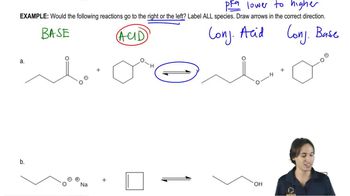
Determining Acid/Base Equilibrium