Ch. 14 - NMR Spectroscopy
Bruice - Organic Chemistry 8th Edition
Bruice8th EditionOrganic ChemistryISBN: 9780135213711Non è quello che usi tu?Cambia libro di testo
Capitolo 14, Problema 41a(7)

Answer the following questions for each compound:
a. How many signals are in its 13C NMR spectrum? b. Which signal is at the lowest frequency?
7.

Guida verificata passo dopo passo
1
Step 1: Analyze the structure of the compound provided. The molecule is a ketone with two carbonyl groups and a linear alkyl chain. Identify all unique carbon environments in the molecule.
Step 2: Determine the number of unique carbon environments. In 13C NMR spectroscopy, each unique carbon environment corresponds to a distinct signal. Look for symmetry and identical groups to reduce the number of signals.
Step 3: Assign the chemical shifts to each carbon environment. Carbonyl carbons (C=O) typically appear at high frequencies (downfield), while alkyl carbons appear at lower frequencies (upfield). Consider the electronic environment and proximity to electronegative groups.
Step 4: Identify the signal at the lowest frequency. The lowest frequency signal corresponds to the carbon in the least deshielded environment, typically a methyl or methylene group far from electronegative groups or π systems.
Step 5: Summarize the findings. State the total number of signals in the 13C NMR spectrum and specify which carbon corresponds to the lowest frequency signal based on its electronic environment.

Risposta video verificata per un problema simile:

Questa soluzione video è stata consigliata dai nostri tutor come utile per risolvere questo problema.
Durata del video:
4m

Concetti chiave

Ecco i concetti essenziali che devi comprendere per rispondere correttamente alla domanda.

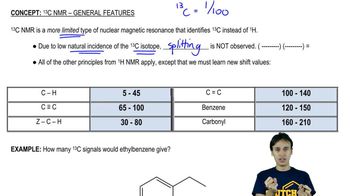
13C NMR Spectroscopy

13C NMR (Nuclear Magnetic Resonance) spectroscopy is a technique used to determine the structure of organic compounds by analyzing the carbon atoms in a molecule. Each unique carbon environment in a compound produces a distinct signal in the NMR spectrum. The number of signals corresponds to the number of different carbon environments, allowing chemists to infer structural information about the compound.
Video consigliato:
04:00
13C NMR General Features

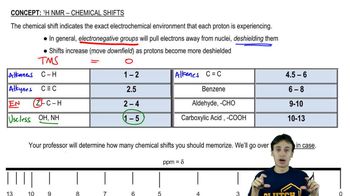
Chemical Shifts

Chemical shifts in NMR spectroscopy refer to the resonance frequency of a nucleus relative to a standard in a magnetic field. In 13C NMR, the chemical shift is influenced by the electronic environment surrounding the carbon atom, including electronegative atoms and hybridization. Signals appear at different frequencies, with lower frequency signals typically indicating more shielded environments, such as those near electron-donating groups.
Video consigliato:
11:44
1H NMR Chemical Shifts

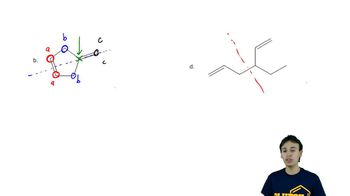
Signal Interpretation

Interpreting signals in an NMR spectrum involves analyzing the number of signals, their positions, and their intensities. Each signal corresponds to a unique carbon environment, and the position of the signal indicates the chemical shift. By understanding the structure of the compound, one can predict which signal will appear at the lowest frequency, often associated with carbonyl groups or other electron-withdrawing functionalities.
Video consigliato:
02:02
Identifying Proton Signals