Ch. 14 - NMR Spectroscopy
Bruice - Organic Chemistry 8th Edition
Bruice8th EditionOrganic ChemistryISBN: 9780135213711Non è quello che usi tu?Cambia libro di testo
Capitolo 14, Problema 42(1)

Describe the proton-coupled 13C NMR spectra for compound 1 in Problem 41, indicating the relative positions of the signals.
1. CH3CH2CH2Br

Guida verificata passo dopo passo
1
Understand the context of the problem: Proton-coupled 13C NMR spectra provide information about the carbon atoms in a molecule and their coupling to directly attached hydrogen atoms. The splitting patterns in the spectra arise due to the spin-spin coupling between 13C nuclei and the protons attached to them.
Identify the structure of compound 1 from Problem 41 (not provided here). Analyze the molecular structure to determine the number of unique carbon environments. Each unique carbon environment corresponds to a distinct signal in the 13C NMR spectrum.
Determine the number of hydrogens attached to each carbon atom. The splitting pattern of each 13C signal in a proton-coupled spectrum is determined by the number of directly attached hydrogens (n). The splitting follows the (n+1) rule, where n is the number of attached protons.
Assign the relative positions of the signals based on the chemical environment of each carbon. Carbons in electron-rich environments (e.g., near alkyl groups) will appear upfield (lower chemical shift), while carbons in electron-deficient environments (e.g., near electronegative atoms or π-systems) will appear downfield (higher chemical shift).
Combine the splitting information and chemical shift trends to describe the relative positions and splitting patterns of the signals in the proton-coupled 13C NMR spectrum. For example, a carbon with three attached hydrogens (CH3) will show a quartet, while a carbon with two attached hydrogens (CH2) will show a triplet.

Risposta video verificata per un problema simile:

Questa soluzione video è stata consigliata dai nostri tutor come utile per risolvere questo problema.

Concetti chiave

Ecco i concetti essenziali che devi comprendere per rispondere correttamente alla domanda.

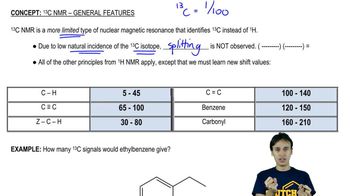
Proton-Coupled 13C NMR Spectroscopy

Proton-coupled 13C NMR spectroscopy is a technique that provides information about the carbon environment in organic compounds by observing how carbon signals are influenced by nearby protons. In this method, the coupling between protons and carbon atoms leads to splitting patterns in the NMR signals, which can help identify the number of protons attached to each carbon and their relative positions.
Video consigliato:
04:00
13C NMR General Features

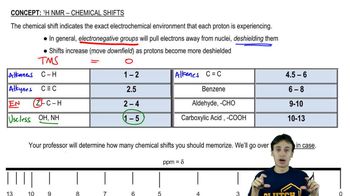
Chemical Shift

Chemical shift refers to the position of an NMR signal relative to a standard reference, typically measured in parts per million (ppm). In 13C NMR, the chemical shift is influenced by the electronic environment surrounding the carbon atom, which can vary based on factors such as hybridization, electronegativity of nearby atoms, and functional groups. Understanding chemical shifts is crucial for interpreting the spectra and determining the structure of the compound.
Video consigliato:
11:44
1H NMR Chemical Shifts

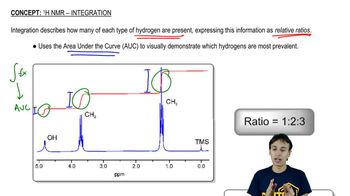
Signal Splitting and Integration

Signal splitting in NMR occurs due to the interaction between non-equivalent neighboring protons, leading to multiple peaks for a single carbon signal. The pattern of splitting (e.g., doublets, triplets) provides insight into the number of adjacent protons, while integration of the peaks indicates the relative number of protons contributing to each signal. This information is essential for deducing the connectivity and arrangement of atoms in the molecule.
Video consigliato:
06:46
1H NMR Integration