Ch. 14 - NMR Spectroscopy
Bruice - Organic Chemistry 8th Edition
Bruice8th EditionOrganic ChemistryISBN: 9780135213711Non è quello che usi tu?Cambia libro di testo
Capitolo 14, Problema 49c

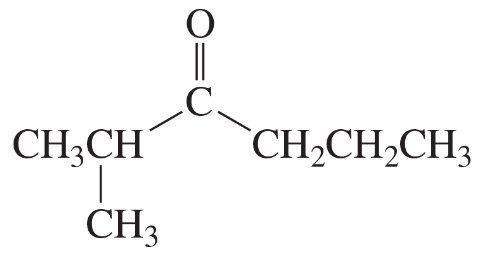
Label each set of chemically equivalent protons, using a for the set that will be at the lowest frequency in the 1H NMR spectrum, b for the next lowest, and so on. Indicate the multiplicity of each signal.
c.

Guida verificata passo dopo passo
1
Step 1: Analyze the structure of the molecule provided. The molecule is a cyclohexanone derivative with a methyl group attached to the alpha-carbon (the carbon adjacent to the carbonyl group).
Step 2: Identify the sets of chemically equivalent protons. Chemically equivalent protons are those in identical chemical environments. In this molecule, there are three distinct sets of protons: (a) the protons on the methyl group, (b) the protons on the alpha-carbon, and (c) the protons on the other carbons of the cyclohexane ring.
Step 3: Determine the relative chemical shift of each set of protons in the 1H NMR spectrum. The methyl group protons (CH₃) will appear at the lowest frequency (upfield) due to their electron-donating environment. The alpha-carbon protons will appear at a slightly higher frequency (downfield) due to their proximity to the electron-withdrawing carbonyl group. The ring protons will appear at various frequencies depending on their positions relative to the carbonyl group.
Step 4: Assign labels to each set of protons based on their chemical shift. Label the methyl group protons as 'a' (lowest frequency), the alpha-carbon protons as 'b' (next lowest frequency), and the ring protons as 'c' (higher frequency).
Step 5: Indicate the multiplicity of each signal. The methyl group protons will appear as a singlet because they are not coupled to any neighboring protons. The alpha-carbon protons will appear as a doublet due to coupling with the methyl group protons. The ring protons will exhibit complex splitting patterns depending on their coupling with adjacent protons.

Risposta video verificata per un problema simile:

Questa soluzione video è stata consigliata dai nostri tutor come utile per risolvere questo problema.
Durata del video:
6m

Concetti chiave

Ecco i concetti essenziali che devi comprendere per rispondere correttamente alla domanda.

Chemical Equivalence

Chemical equivalence refers to protons in a molecule that are in identical environments, leading to them having the same chemical shift in NMR spectroscopy. In the context of the provided structure, identifying equivalent protons is crucial for labeling them correctly in the NMR spectrum, as they will produce the same signal.
Video consigliato:
Percorso guidato
3:11
Chemical Reactions of Phosphate Anhydrides Concept 1

NMR Multiplicity

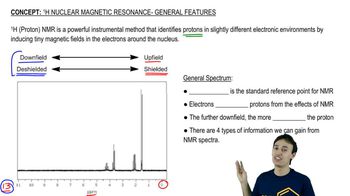
Multiplicity in NMR spectroscopy describes the splitting of NMR signals due to spin-spin coupling between neighboring protons. The number of peaks in a signal is determined by the n+1 rule, where n is the number of neighboring protons. Understanding multiplicity helps in interpreting the complexity of the NMR spectrum and the connectivity of protons in the molecule.
Video consigliato:
10:06
General NMR Features

Chemical Shift

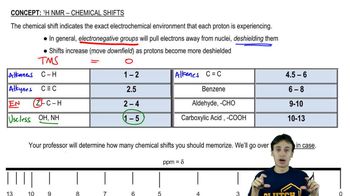
Chemical shift is a key concept in NMR that indicates the resonance frequency of a nucleus relative to a standard reference, typically measured in parts per million (ppm). It provides insight into the electronic environment surrounding the protons, allowing chemists to deduce structural information about the molecule. In the context of the question, identifying the lowest frequency protons is essential for proper labeling.
Video consigliato:
11:44
1H NMR Chemical Shifts