Ch. 17 - Reactions at the Alpha-Carbon
Bruice - Organic Chemistry 8th Edition
Bruice8th EditionOrganic ChemistryISBN: 9780135213711Non è quello che usi tu?Cambia libro di testo
Capitolo 17, Problema 43b

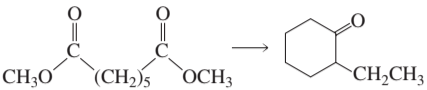
Design a synthesis for each of the following compounds using the given starting material:
b. Chemical structures of two compounds on the left leading to a product on the right, with arrows indicating synthesis.

Guida verificata passo dopo passo
1
Analyze the target compound and identify the functional groups present. Determine the transformations required to convert the starting material into the target compound.
Examine the starting material and assess its structure. Identify the functional groups and carbon skeleton to determine how it can be modified to achieve the target compound.
Plan the synthesis by selecting appropriate reactions for each transformation. Consider reagents, reaction conditions, and intermediates that will lead to the desired product.
Sequence the reactions logically, ensuring that each step is compatible with the functional groups present and does not interfere with subsequent steps.
Verify the retrosynthetic pathway by checking that each intermediate can be synthesized from the previous step and that the final product matches the target compound.

Risposta video verificata per un problema simile:

Questa soluzione video è stata consigliata dai nostri tutor come utile per risolvere questo problema.

Concetti chiave

Ecco i concetti essenziali che devi comprendere per rispondere correttamente alla domanda.

Retrosynthetic Analysis

Retrosynthetic analysis is a strategy used in organic chemistry to deconstruct a target molecule into simpler precursor structures. This method involves identifying functional groups and breaking down the molecule into smaller, more manageable components, allowing chemists to plan a synthetic route. By working backward from the desired compound, chemists can determine the necessary reactions and starting materials needed for synthesis.
Video consigliato:
01:22
Retrosynthesis

Functional Groups

Functional groups are specific groups of atoms within molecules that are responsible for the characteristic chemical reactions of those molecules. Understanding functional groups is essential for predicting reactivity and determining the appropriate synthetic pathways. Common functional groups include alcohols, amines, carboxylic acids, and alkenes, each influencing the molecule's properties and behavior in reactions.
Video consigliato:
02:36
Identifying Functional Groups

Reaction Mechanisms

Reaction mechanisms describe the step-by-step sequence of events that occur during a chemical reaction, detailing how reactants transform into products. Understanding these mechanisms is crucial for predicting the outcomes of reactions and for designing effective synthetic routes. Key concepts include nucleophiles, electrophiles, and intermediates, which help explain how bonds are formed and broken throughout the reaction process.
Video consigliato:
02:16
Heck Reaction Mechanism