Ch. 17 - Reactions at the Alpha-Carbon
Bruice - Organic Chemistry 8th Edition
Bruice8th EditionOrganic ChemistryISBN: 9780135213711Non è quello che usi tu?Cambia libro di testo
Capitolo 17, Problema 19b

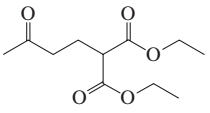
What reagents should be used to prepare the following compounds?
b. Chemical structure illustrating the Michael addition reaction with multiple carbonyl groups and alkyl substituents.

Guida verificata passo dopo passo
1
Step 1: Analyze the target compound. The structure contains two ester groups (-COOCH3), one ketone group (-CO), and a methyl ether (-OCH3). This suggests that the compound could be synthesized using a combination of esterification, aldol condensation, and ether formation reactions.
Step 2: Identify the backbone of the molecule. The central carbon is connected to two carbonyl groups and one methoxy group. This indicates that the molecule could be formed via a reaction involving a β-keto ester synthesis.
Step 3: Plan the synthesis of the β-keto ester. Start with a simple ester, such as methyl acetate (CH3COOCH3), and react it with an enolate formed from acetone (CH3COCH3) in the presence of a base like sodium ethoxide (NaOEt). This will form the β-keto ester intermediate.
Step 4: Introduce the second ester group. React the β-keto ester intermediate with methyl chloroformate (CH3OCOCl) under basic conditions to add the second ester group to the molecule.
Step 5: Add the methoxy group. Use a Williamson ether synthesis to introduce the methoxy group (-OCH3) by reacting the intermediate with methyl iodide (CH3I) in the presence of a strong base like sodium hydride (NaH).

Risposta video verificata per un problema simile:

Questa soluzione video è stata consigliata dai nostri tutor come utile per risolvere questo problema.
Durata del video:
5m

Concetti chiave

Ecco i concetti essenziali che devi comprendere per rispondere correttamente alla domanda.

Michael Addition

Michael addition is a nucleophilic addition reaction where a nucleophile adds to an α,β-unsaturated carbonyl compound. This reaction typically involves the addition of a carbanion or another nucleophile to the β-carbon of the unsaturated system, forming a new carbon-carbon bond. Understanding this mechanism is crucial for determining the appropriate reagents to synthesize compounds that feature this type of reactivity.
Video consigliato:
09:23
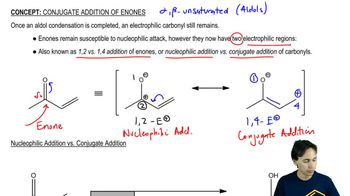
1,2 vs 1,4 Addition

Reagents for Michael Addition

Common reagents for performing a Michael addition include strong bases like sodium hydride (NaH) or lithium diisopropylamide (LDA) to generate the nucleophile, often a stabilized carbanion. Additionally, the α,β-unsaturated carbonyl compound, such as an enone or enal, serves as the electrophile. Identifying the correct combination of these reagents is essential for successfully preparing the desired compound.
Video consigliato:
09:23
1,2 vs 1,4 Addition

Functional Groups in Organic Synthesis

Understanding the functional groups present in the target compound is vital for selecting the appropriate synthetic pathway. The compound in the image contains multiple carbonyl groups and an ether, which influence its reactivity and the choice of reagents. Recognizing how these functional groups interact during reactions helps in predicting the outcomes and optimizing the synthesis process.
Video consigliato:
02:36
Identifying Functional Groups