Ch. 18 - Reactions of Benzene and Substituted Benzenes
Bruice - Organic Chemistry 8th Edition
Bruice8th EditionOrganic ChemistryISBN: 9780135213711Non è quello che usi tu?Cambia libro di testo
Capitolo 18, Problema 68b

A mixture of 0.10 mol benzene and 0.10 mol p-xylene was allowed to react with 0.10 mol nitronium ion until all the nitronium ion was gone. Two products were obtained: 0.002 mol of one and 0.098 mol of the other.
b. Why was more of one product obtained than of the other?

Guida verificata passo dopo passo
1
Step 1: Understand the reaction. The nitronium ion (NO₂⁺) is an electrophile that reacts with benzene and p-xylene in an electrophilic aromatic substitution reaction. Benzene and p-xylene are the reactants, and the products are nitrobenzene and nitro-p-xylene, respectively.
Step 2: Analyze the reactivity of benzene and p-xylene. Benzene is less reactive toward electrophilic aromatic substitution because it lacks electron-donating groups. In contrast, p-xylene has two methyl groups, which are electron-donating and activate the aromatic ring, making it more reactive toward the nitronium ion.
Step 3: Consider the regioselectivity of the reaction. The methyl groups on p-xylene direct the nitronium ion to the ortho and para positions due to their electron-donating inductive and hyperconjugative effects. This increases the likelihood of nitro-p-xylene formation compared to nitrobenzene.
Step 4: Relate the product distribution to the reactivity. Since p-xylene is more reactive than benzene, it reacts preferentially with the nitronium ion. This explains why a larger amount of nitro-p-xylene (0.098 mol) was formed compared to nitrobenzene (0.002 mol).
Step 5: Conclude the reasoning. The difference in product amounts is due to the higher reactivity of p-xylene, which is activated by its methyl groups, compared to benzene, which lacks activating substituents. This leads to a preferential reaction of the nitronium ion with p-xylene.

Risposta video verificata per un problema simile:

Questa soluzione video è stata consigliata dai nostri tutor come utile per risolvere questo problema.
Durata del video:
6m

Concetti chiave

Ecco i concetti essenziali che devi comprendere per rispondere correttamente alla domanda.

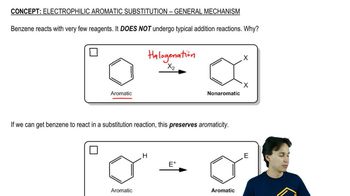
Electrophilic Aromatic Substitution

Electrophilic aromatic substitution (EAS) is a fundamental reaction in organic chemistry where an electrophile replaces a hydrogen atom on an aromatic ring. In this case, the nitronium ion acts as the electrophile, attacking the benzene and p-xylene. The reactivity of the aromatic compounds and the stability of the resulting intermediates influence the distribution of products formed.
Video consigliato:
03:07
EAS Review

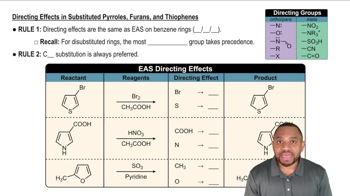
Substituent Effects on Reactivity

The presence of substituents on an aromatic ring can significantly affect its reactivity towards electrophiles. In the case of p-xylene, which has two methyl groups, these groups are electron-donating and activate the ring towards further substitution. This results in a higher likelihood of forming one product over the other, depending on the position of substitution and the stability of the intermediates.
Video consigliato:
Percorso guidato
3:26
Directing Effects in Substituted Pyrroles, Furans, and Thiophenes Concept 2

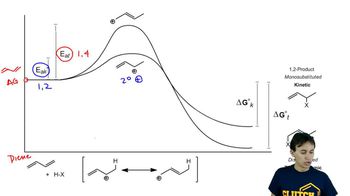
Product Distribution and Kinetics

The distribution of products in a reaction can be influenced by both thermodynamic and kinetic factors. In this scenario, the formation of one product over the other may be due to the stability of the transition states or intermediates involved in the reaction. The more stable product is often formed in greater quantities, reflecting the reaction's pathway and the relative energies of the products.
Video consigliato:
08:51
Kinetic vs. Thermodynamic Control