Ch. 18 - Reactions of Benzene and Substituted Benzenes
Bruice - Organic Chemistry 8th Edition
Bruice8th EditionOrganic ChemistryISBN: 9780135213711Non è quello che usi tu?Cambia libro di testo
Capitolo 18, Problema 16a

Draw the resonance contributors for:
a. benzaldehyde

Guida verificata passo dopo passo
1
Step 1: Begin by identifying the structure of benzaldehyde. Benzaldehyde consists of a benzene ring (aromatic system) attached to a formyl group (-CHO). The benzene ring provides a conjugated π-electron system, which is key for resonance.
Step 2: Focus on the formyl group (-CHO). The carbonyl group (C=O) in the formyl group has a polarized bond due to the electronegativity difference between carbon and oxygen. Oxygen has a lone pair of electrons that can participate in resonance.
Step 3: Draw the first resonance contributor. In this structure, the π-electrons from the benzene ring remain localized, and the formyl group retains its double bond (C=O). This is the 'standard' structure of benzaldehyde.
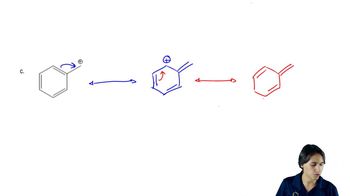
Step 4: Draw the second resonance contributor. In this structure, the π-electrons from the benzene ring delocalize toward the carbonyl group. This results in a negative charge on the oxygen atom and a positive charge on the carbon atom of the formyl group. The benzene ring now has a formal positive charge on one of its carbons.
Step 5: Draw additional resonance contributors by shifting the π-electrons within the benzene ring. The delocalization of electrons can create multiple resonance structures where the formal charges move around the ring, maintaining aromaticity. Ensure all resonance contributors follow the rules of resonance (e.g., conserving the total number of electrons and maintaining the aromaticity of the benzene ring).

Risposta video verificata per un problema simile:

Questa soluzione video è stata consigliata dai nostri tutor come utile per risolvere questo problema.
Durata del video:
8m

Concetti chiave

Ecco i concetti essenziali che devi comprendere per rispondere correttamente alla domanda.

Resonance Structures

Resonance structures are different Lewis structures for a molecule that depict the same arrangement of atoms but differ in the distribution of electrons. These structures help illustrate the delocalization of electrons within a molecule, which is particularly important in understanding the stability and reactivity of compounds like benzaldehyde.
Video consigliato:
03:04
Drawing Resonance Structures

Benzaldehyde Structure

Benzaldehyde is an aromatic compound consisting of a benzene ring attached to a formyl group (-CHO). The presence of the carbonyl group introduces a site of reactivity and influences the resonance contributors, as the double bond between carbon and oxygen can participate in resonance with the π electrons of the benzene ring.
Video consigliato:
03:04
Drawing Resonance Structures

Aromaticity

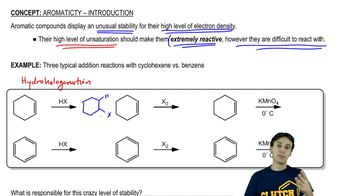
Aromaticity refers to the enhanced stability of cyclic compounds with conjugated pi electron systems that follow Hückel's rule (4n + 2 π electrons). In benzaldehyde, the aromatic nature of the benzene ring allows for resonance stabilization, which is crucial for understanding the electronic properties and reactivity of the molecule.
Video consigliato:
08:19
Intro to Aromaticity