Indietro
Problema 62
Which of the following compounds reacts with HBr more rapidly?
Problema 64
An aromatic hydrocarbon with a molecular formula of C13H20 has an 1H NMR spectrum with a signal at ~7 ppm that integrates to 5H. It also has two singlets; one of the singlets has 1.5 times the area of the second. What is the structure of the aromatic hydrocarbon?
Problema 65a
Show how the following compounds can be synthesized from benzene:
a. N,N,N-trimethylanilinium iodide
Problema 65g
Show how the following compounds can be synthesized from benzene:
g. p-dideuteriobenzene
Problema 65h
Show how the following compounds can be synthesized from benzene:
h. p-nitro-N-methylaniline
Problema 66a
Use the four compounds shown below to answer the following questions:
a. Why are the ortho-halo-substituted benzoic acids stronger acids than benzoic acid?
Problema 66b
Use the four compounds shown below to answer the following questions:
b. Why is o-fluorobenzoic acid the weakest of the ortho-halo-substituted benzoic acids?
Problema 67a
a. Rank the following esters from most reactive to least reactive in the first slow step of a nucleophilic acyl substitution reaction (formation of the tetrahedral intermediate):
Problema 67b
b. Rank the same esters from most reactive to least reactive in the second slow step of a nucleophilic acyl substitution reaction (collapse of the tetrahedral intermediate).
Problema 68b
A mixture of 0.10 mol benzene and 0.10 mol p-xylene was allowed to react with 0.10 mol nitronium ion until all the nitronium ion was gone. Two products were obtained: 0.002 mol of one and 0.098 mol of the other.
b. Why was more of one product obtained than of the other?
Problema 69
Does m-xylene or p-xylene react more rapidly with Cl2 + FeCl3? Explain your answer.
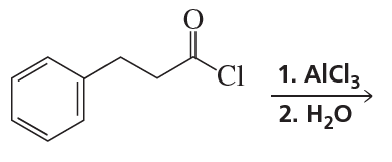
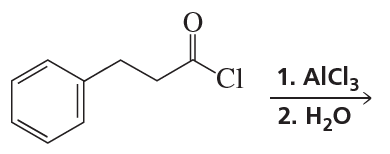
Problema 70(a)
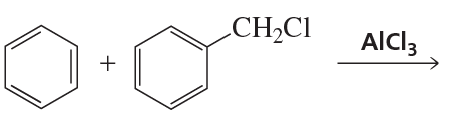
What are the products of the following reactions?
a.
Problema 70a
What are the products of the following reactions?
a.
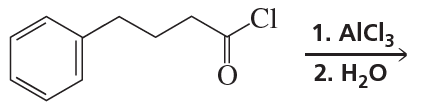
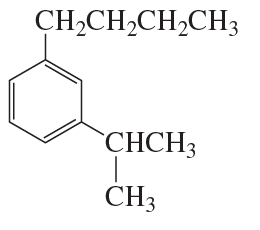
Problema 70b
What are the products of the following reactions?
b.
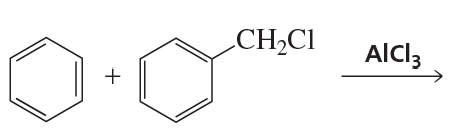
Problema 70(c)
What are the products of the following reactions?
c.
Problema 70c
What are the products of the following reactions?
c.
Problema 71
Benzene underwent a Friedel–Crafts acylation followed by a Wolff–Kishner reduction. The product gave the following 1H NMR spectrum. What acyl chloride was used in the Friedel–Crafts acylation?
<IMAGE>
Problema 72b
What products are obtained from the reaction of the following compounds with H2CrO4 + ∆?
b.
Problema 73
Which set of underlined hydrogens has its 1H NMR signal at a higher frequency?
a. CH3CH2CH3 or CH3OCH2CH3
b. CH3CH=CH2 or CH3OCH=CH2
Problema 75a
Show how the following compounds can be prepared from the given starting materials. You can use any necessary organic or inorganic reagents.
a.
Problema 76
Rank the following compounds from largest Keq to smallest Keq for hydrate formation:
Problema 78a
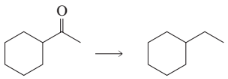
a. Describe three ways the following reaction can be carried out:
Problema 78b
b. Describe two ways the following reaction can be carried out:
Problema 79a
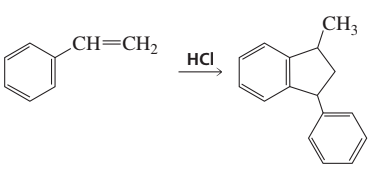
Propose a mechanism for each of the following reactions:
a.
Problema 79b
Propose a mechanism for each of the following reactions:
b.
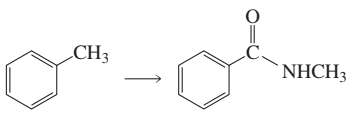
Problema 80c
How can you prepare the following compounds with benzene as one of the starting materials?
c.
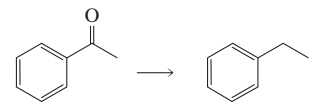
Problema 80d
How can you prepare the following compounds with benzene as one of the starting materials?
d.
Problema 81
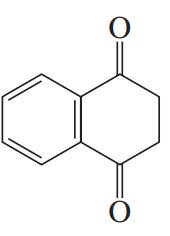
Describe how naphthalene can be prepared from the given starting material.
Problema 82
Using resonance contributors for the carbocation intermediate, explain why a phenyl group is an ortho–para director.
Problema 83
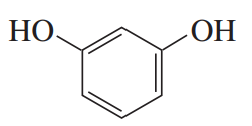
Describe two synthetic routes for the preparation of p-methoxyaniline from benzene.