Indietro
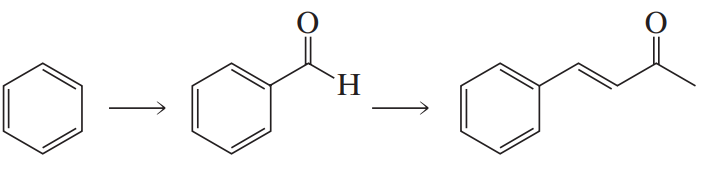
Problema 84a
What reagents are required to carry out the following synthesis?
Problema 84b
What reagents are required to carry out the following synthesis?
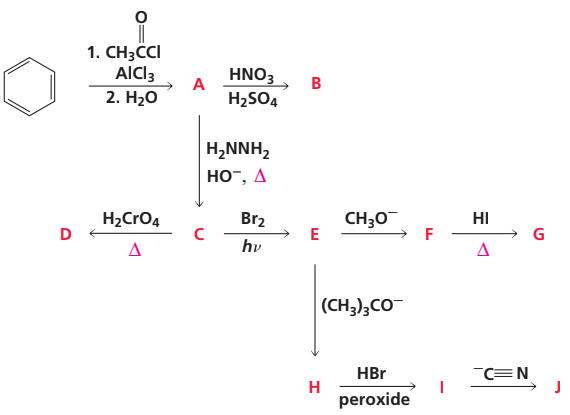
Problema 85a
Identify A–J:
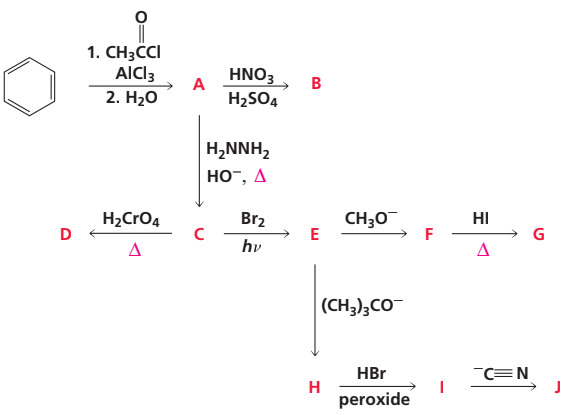
Problema 85b
Identify A–J:
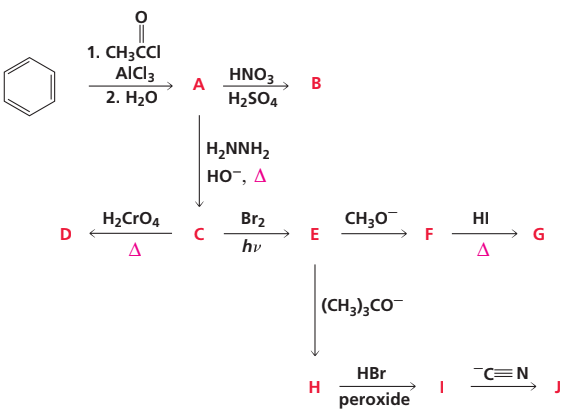
Problema 85c
Identify A–J:
Problema 87a
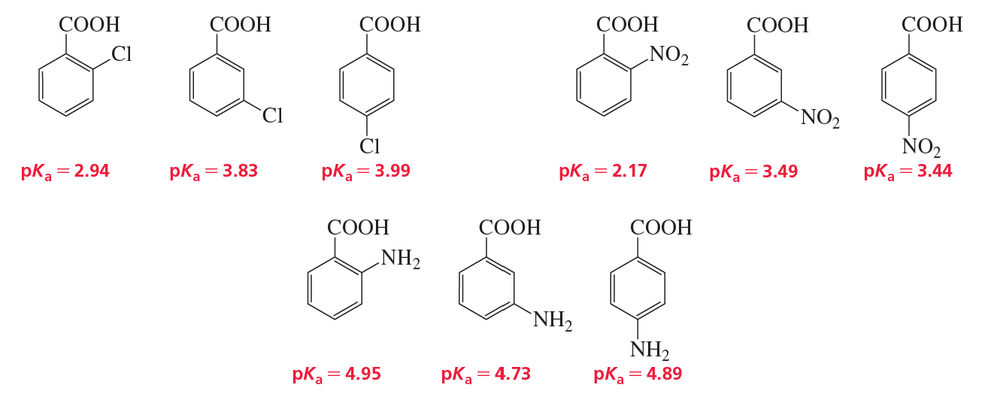
The pKa values of a few ortho-, meta-, and para-substituted benzoic acids are shown below:
The relative pKa values depend on the substituent. For chloro-substituted benzoic acids, the ortho isomer is the most acidic and the para isomer is the least acidic; for nitro-substituted benzoic acids, the ortho isomer is the most acidic and the meta isomer is the least acidic; and for amino-substituted benzoic acids, the meta isomer is the most acidic and the ortho isomer is the least acidic.
Explain these relative acidities.
a. Cl: ortho > meta > para
Problema 87c
The pKa values of a few ortho-, meta-, and para-substituted benzoic acids are shown below:
The relative pKa values depend on the substituent. For chloro-substituted benzoic acids, the ortho isomer is the most acidic and the para isomer is the least acidic; for nitro-substituted benzoic acids, the ortho isomer is the most acidic and the meta isomer is the least acidic; and for amino-substituted benzoic acids, the meta isomer is the most acidic and the ortho isomer is the least acidic. Explain these relative acidities.
c. NH2: meta > para > ortho
Problema 88a
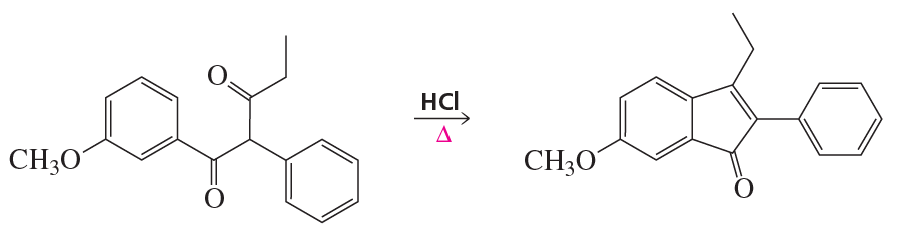
Propose a mechanism for each of the following reactions:
a.
Problema 88b
Propose a mechanism for each of the following reactions:
b.
Problema 90
When heated with chromic acid, compound A forms benzoic acid. Identify compound A from its 1H NMR spectrum.
<IMAGE>
Problema 91c
Show how the following compounds can be prepared from benzene:
c.
Problema 92a
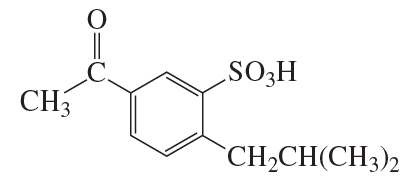
How can you distinguish the following compounds using: a. their infrared spectra?
Problema 94
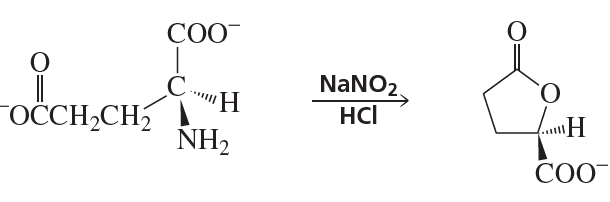
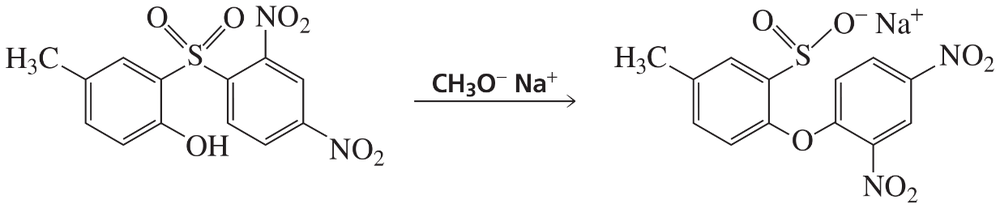
Propose a mechanism for the following reaction that explains why the configuration of the asymmetric center in the reactant is retained in the product:
Problema 95
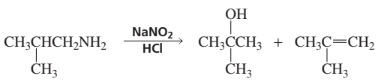
Propose a mechanism for each of the following reactions:
b.
Problema 96
Describe how 3-methyl-1-phenyl-3-pentanol can be prepared from benzene. You can use any inorganic reagents and solvents, and any organic reagents provided they contain no more than two carbons.
Problema 98a
a. Explain why the following reaction leads to the products shown:
Problema 99
Explain why hydroxide ion catalyzes the reaction of piperidine with 2,4-dinitroanisole but has no effect on the reaction of piperidine with 1-chloro-2,4-dinitrobenzene.
Problema 101a
Tyramine is an alkaloid found in mistletoe and ripe cheese. Dopamine is a neurotransmitter involved in the regulation of the central nervous system.
a. How can tyramine be prepared from b-phenylethylamine?
Problema 101b
Tyramine is an alkaloid found in mistletoe and ripe cheese. Dopamine is a neurotransmitter involved in the regulation of the central nervous system.
b. How can dopamine be prepared from tyramine?
Problema 101c
Tyramine is an alkaloid found in mistletoe and ripe cheese. Dopamine is a neurotransmitter involved in the regulation of the central nervous system.
c. Give two ways to prepare b-phenylethylamine from b-phenylethyl chloride.
Problema 101d
Tyramine is an alkaloid found in mistletoe and ripe cheese. Dopamine is a neurotransmitter involved in the regulation of the central nervous system.
d. How can b-phenylethylamine be prepared from benzyl chloride?
Problema 101e
Tyramine is an alkaloid found in mistletoe and ripe cheese. Dopamine is a neurotransmitter involved in the regulation of the central nervous system.
e. How can b-phenylethylamine be prepared from benzaldehyde?
Problema 102b
Ibuprofen is the active ingredient in pain relievers such as Advil, Motrin, and Nuprin. How can ibuprofen be synthesized from benzene?
Problema 102c
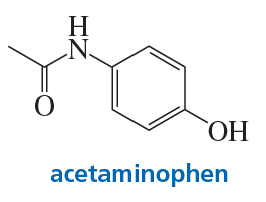
Acetaminophen is the active ingredient in Tylenol. How can acetominophen be synthesized from benzene?