Indietro
Problema 24i
Show how each of the following compounds can be synthesized from benzene:
i. 1-phenyl-2-propanol
Problema 25a
What is the major product(s) of each of the following reactions?
a. bromination of p-methylbenzoic acid
Problema 25b
What is the major product(s) of each of the following reactions?
b. chlorination of o-benzenedicarboxylic acid
Problema 25e,f
What is the major product(s) of each of the following reactions?
e. nitration of p-methoxybenzaldehyde
f. nitration of p-tert-butylmethylbenzene
Problema 28
Why isn’t FeBr3 used as a catalyst in the first step of the synthesis of 1,3,5-tribromobenzene?
Problema 29
Explain why a diazonium group on a benzene ring cannot be used to direct an incoming substituent to the meta position.
Problema 31d
Show how the following compounds can be synthesized from benzene:
d. m-methylnitrobenzene
Problema 32
What product is formed from the reaction of p-methylphenol with benzenediazonium chloride?
Problema 33
In the mechanism for electrophilic aromatic substitution with a diazonium ion as the electrophile, why does nucleophilic attack occur on the terminal nitrogen of the diazonium ion rather than on the nitrogen that has the formal positive charge?
Problema 34
Draw the structure of the activated benzene ring and the diazonium ion used in the synthesis of each of the following compounds, whose structures can be found on page 607.
b. methyl orange
Problema 35
Which amide bond is hydrolyzed in the first step of the conversion of temozolomide to methyldiazonium?
Problema 37
Diazomethane can be used to convert a carboxylic acid to a methyl ester. Propose a mechanism for this reaction.
Problema 38
Draw resonance contributors for the carbanion that would be formed if meta-chloronitrobenzene were to react with hydroxide ion. Why doesn't the reaction occur?
Problema 39a
Rank the following compounds from greatest tendency to least tendency to undergo nucleophilic aromatic substitution:
chlorobenzene
1-chloro-2,4-dinitrobenzene
p-chloronitrobenzene
Problema 39b
b. Rank the same compounds from greatest tendency to least tendency to undergo electrophilic aromatic substitution.
chlorobenzene, 1-chloro-2,4-dinitrobenzene, p-chloronitrobenzene
Problema 40c
Show how each of the following compounds can be synthesized from benzene:
c. p-bromoanisole
Problema 40d
Show how each of the following compounds can be synthesized from benzene:
d. anisole
Problema 41a
Design a synthesis for each of the following, using an intramolecular reaction:
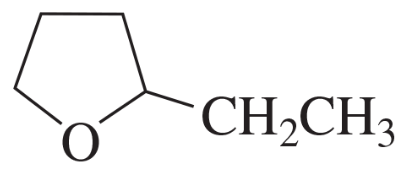
a.
Problema 41d
Design a synthesis for each of the following, using an intramolecular reaction:
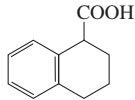
d.
Problema 41e
Design a synthesis for each of the following, using an intramolecular reaction:
e.
Problema 41f
Design a synthesis for each of the following, using an intramolecular reaction:
f.
Problema 42d,e,f
Draw the structure for each of the following:
d. benzaldehyde
e. anisole
f. styrene
Problema 42g,h,i
Draw the structure for each of the following:
g. toluene
h. tert-butylbenzene
i. benzyl chloride
Problema 43c
Name the following:
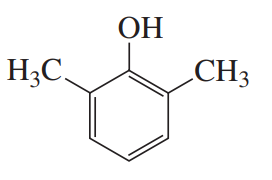
c.
Problema 43d
Name the following:
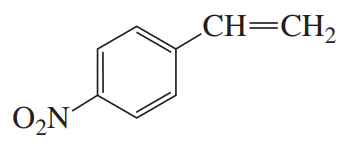
d.
Problema 43e,f
Name the following:
e.
f.
Problema 43g,h,i
Name the following:
g.
h.
i.
Problema 44
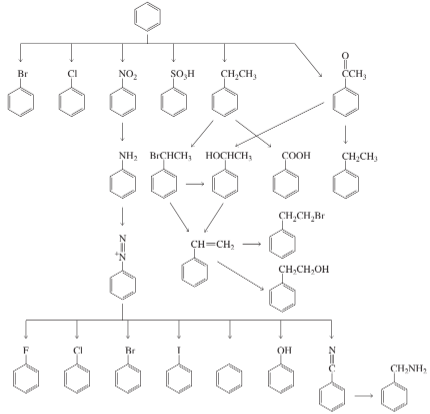
Provide the necessary reagents next to the arrows.
Problema 45a
Draw the structure for each of the following:
a. m-ethylphenol
Problema 45b
Draw the structure for each of the following:
b. p-nitrobenzenesulfonic acid