Ch. 2 - Acids and Bases: Central to Understanding Organic Chemistry
Bruice - Organic Chemistry 8th Edition
Bruice8th EditionOrganic ChemistryISBN: 9780135213711Non è quello che usi tu?Cambia libro di testo
Capitolo 2, Problema 8a

Antacids are compounds that neutralize stomach acid. Write the equations that show how Milk of Magnesia, Alka-Seltzer, and Tums remove excess acid.
a. Milk of Magnesia: Mg(OH)2
b. Alka-Seltzer: KHCO3 and NaHCO3
c. Tums: CaCO3

Guida verificata passo dopo passo
1
Step 1: Understand the problem. The question asks for the chemical equations that show how the active ingredients in Milk of Magnesia, Alka-Seltzer, and Tums neutralize stomach acid (HCl). Neutralization reactions involve an acid (HCl) reacting with a base to form water and a salt (or other products).
Step 2: Write the equation for Milk of Magnesia (Mg(OH)2). Magnesium hydroxide reacts with hydrochloric acid (HCl) in a 1:2 molar ratio. The reaction is: Mg(OH)2+2HCl→MgCl2+2H2O.
Step 3: Write the equation for Alka-Seltzer (KHCO3 and NaHCO3). Both potassium bicarbonate and sodium bicarbonate react with HCl in a 1:1 molar ratio to produce carbon dioxide (CO2), water (H2O), and a salt. For KHCO3: KHCO3+HCl→KCl+H2O+CO2. For NaHCO3: NaHCO3+HCl→NaCl+H2O+CO2.
Step 4: Write the equation for Tums (CaCO3). Calcium carbonate reacts with HCl in a 1:2 molar ratio to produce calcium chloride (CaCl2), water (H2O), and carbon dioxide (CO2). The reaction is: CaCO3+2HCl→CaCl2+H2O+CO2.
Step 5: Summarize the reactions. Each antacid neutralizes stomach acid by reacting with HCl to form water, a salt, and sometimes carbon dioxide. These reactions reduce the acidity in the stomach, providing relief from symptoms like heartburn.

Risposta video verificata per un problema simile:

Questa soluzione video è stata consigliata dai nostri tutor come utile per risolvere questo problema.
Durata del video:
6m

Concetti chiave

Ecco i concetti essenziali che devi comprendere per rispondere correttamente alla domanda.

Acid-Base Neutralization

Acid-base neutralization is a chemical reaction where an acid reacts with a base to produce water and a salt. In the context of antacids, the base component of the antacid reacts with hydrochloric acid (HCl) in the stomach, effectively reducing acidity. This reaction is crucial for understanding how antacids alleviate symptoms of heartburn and indigestion.
Video consigliato:
02:49
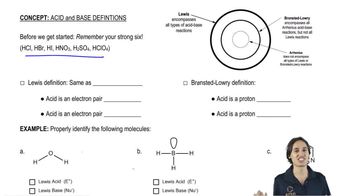
The Lewis definition of acids and bases.

Chemical Equations

Chemical equations represent the reactants and products in a chemical reaction using their chemical formulas. For antacids, writing balanced equations shows how each compound interacts with stomach acid. Understanding how to balance these equations is essential for accurately depicting the stoichiometry of the neutralization reactions.
Video consigliato:
Percorso guidato
3:11
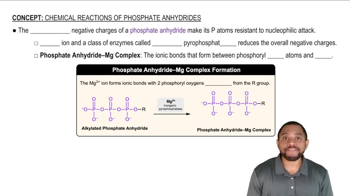
Chemical Reactions of Phosphate Anhydrides Concept 1

Common Antacid Compounds

Common antacid compounds include magnesium hydroxide (Mg(OH)2), potassium bicarbonate (KHCO3), sodium bicarbonate (NaHCO3), and calcium carbonate (CaCO3). Each of these compounds has a specific mechanism for neutralizing stomach acid, and knowing their chemical properties helps in predicting the outcomes of their reactions with HCl. This knowledge is vital for writing the correct chemical equations for each antacid.
Video consigliato:
01:40
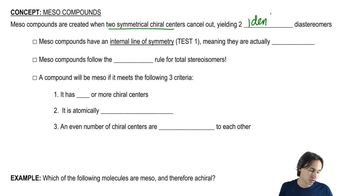
Defining meso compounds.